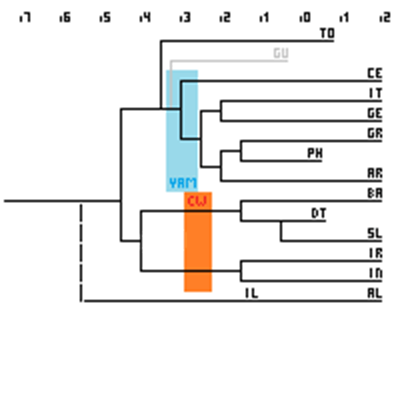
This is a new cladogram of the Indo-European language family. It is meant to replace the one I posted a few years ago: A Cladogram of the Indo-European Language Groups – Vellaunos
The numbers at the top are the millennia BCE/CE.
The abbreviations used are the following: TO – Tocharian; GU – Gutian (i.e. “Anatolian”); CE – Celtic; IT – Italic; GE – Germanic; GR – Greek; PH – Phrygian; AR – Armenian; BA – Baltic; DT – Daco-Thracian; SL – Slavic; IR – Iranic; IN – Indic; IL – Illryian; AL – Albanian; YAM – Yamnaya Culture; CW – Corded Ware Culture
(Daco-Thracian includes Cimmerian.)
The Illyrian branch has a dashed line to indicate the high uncertainty of the origin of this branch. My belief is that it originated from a migration of Sredny Stog people westwards (Sredny Stog > Cernavoda > Kostolac…). [See Illyrians and Albanians – Vellaunos]
The Gutian branch is in light gray to indicate my belief that this branch arose from the borrowing of the southern Proto-Indo-European of the Yamnaya people by North Caucasian folks (Novotitorovka). [See The Non-Indo-European Hittites – Vellaunos]
Unlike the previous cladogram, this one doesn’t show the Baltic element that contributed to the formation of Germanic or the Indo-Iranian element that contributed to the formation of the Greek-Phrygian-Armenian group.
 Vellaunos