Celtic and Celtoid

In recent years, certain eminent authorities have advanced the theory that the “Celtic” language developed in the Atlantic region of Western Europe and subsequently spread eastwards. This theory is opposed to the generally held view that the Celtic language developed in Central Europe and expanded from there.

The latter view is entirely correct, but the other view is not entirely wrong. In fact, the Atlantic region of Western Europe was the area in which the Celtoid (rather than Celtic) language developed.

My view is that the Insular “Celtic” languages are an offshoot of Celtic rather than being Celtic; I use the term Celtoid rather than Celtic for these Insular “Celtic” languages. Given the eccentric particularities of the Celtoid languages (VSO word order, initial consonant mutations, conjugated prepositions, etc.) which are not found in any other Indo-European language, it is simply bizarre to believe that these languages could belong in the same group as the Celtic language which was centered in Central Europe between the relatively typical Indo-European Italic and Germanic languages.

Some researchers have tried their best to prove some kind of linguistic unity between Celtic and the Celtoid languages, even going so far as to find Insular “Celtic” features in Gaulish texts that no one really understands properly. I can understand that this mission is dear to the hearts (for some reason), but it’s wrong.

Speaking of a lack of unity, comparing Gaelic and Brittonic reveals many more differences than similarities, particularly in terms of vocabulary. Surely these two can’t equally be derived from Proto-Celtic in the same way that East Germanic, North Germanic and West Germanic are derived from Proto-Germanic.

By the way, it is important to bear in mind that only the “Continental Celts” were called Celts in Antiquity. No ancient writer ever called the peoples living in the British Isles “Celts”. In fact, it was only in the Early Modern Era that the Gaelic and Brittonic peoples started calling themselves “Celts”.

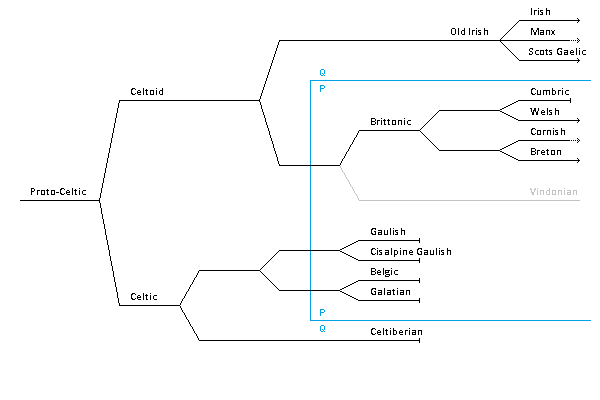
Here’s how I see the development of the Celtic and Celtoid languages:

The origins of the Celts are in the Yamnaya Culture which dominated the Pontic Steppe between c3300 and c2600 BC. During the latter part of this period, groups of Yamnaya people migrated into the lower Danube River valley and followed the Danube into Central Europe. The establishment of these Yamnaya ancestors of the Celts in Central Europe probably dates to the time of the early Bronze Age Bell Beaker Culture which existed between c2800 and c2300 BC.

The origins of the Bell Beaker Culture are debated, but it covered most of Western and Central Europe. After their arrival in Central Europe, the Yamnaya ancestors of the Celts apparently adopted the Bell Beaker Culture. This adoption of the Bell Beaker Culture marks the beginning of the Celts.

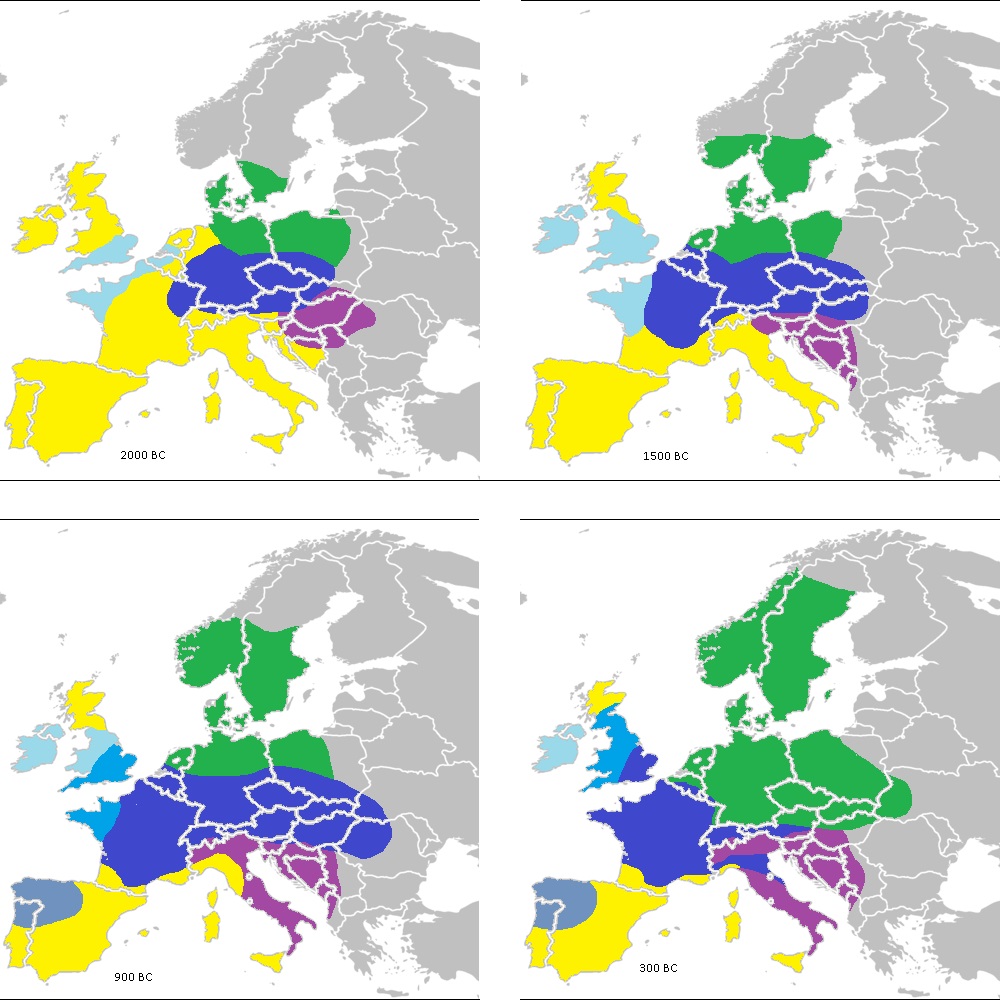
Sometime before 2000 BC, a portion of the earliest Celts of Central Europe migrated westwards. They first migrated into the present-day Netherlands – producing the Hilversum Culture. Further movements westwards brought these earliest Celts into Great Britain – producing the Wessex Culture – and further into Ireland, while others migrated into the Northwest corner of modern France – a region that was called Aremorica (are-mori “by the sea”) two thousand years ago, and which includes Brittany and adjacent areas.

The men among these migrants carried the R1b-P312 Y-DNA haplotype. After their migration, the R1b-L21 haplotype developed among them. This is by far the most common Y-DNA haplotype among modern speakers of the Celtoid languages. Meanwhile, the R1b-U152 Y-DNA haplotype developed among the Celts staying in Central Europe who developed the Unetice Culture (as well as the nearby Italic peoples who were then settled in the area of modern Hungary).

The language that the R1b-L21 folks spoke was originally part of the Proto-Celtic language. But as their language developed among the Atlantic peoples of Western Europe in relative isolation from the Proto-Celtic core territory in Central Europe, it soon diverged significantly from Proto-Celtic. It may well be that the eccentric particularities of the Celtoid language came from the Atlantic peoples of Western Europe among which the R1b-L21 migrants established themselves.

By the middle of the second millennium BC, there were probably two distinct descendants of the Proto-Celtic language: the Celtic language of Central Europe which directly continued Proto-Celtic (successive Tumulus and Urnfield cultures), and the divergent Celtoid language of Western Europe (Atlantic Bronze Age – c1300 to c700 BC). A later offshoot from the Central European Celtic territory (probably during the Urnfield period – c1300 to c750 BC) was the Celtiberian language which established itself in the northwest of Iberia.

The Celtoid language was originally spoken in Aremorica, Great Britain and Ireland, and possibly also in northern France and the Low Countries. It probably also spread southwards up to Gascony, and may even have spread eastwards to some extent, but the Celtoid language on the Continent was probably largely assimilated to the Celtic language as it spread westwards from Central Europe during the Urnfield and Hallstatt periods. Yet, there may have been transitional dialects between Celtic and Celtoid in some areas, especially in Aremorica.

In Great Britain, the influence of Celtic on the Celtoid language during the Hallstatt and LaTène periods (including the kw > p change) produced the Brittonic language. [The change of the kw sound to the p sound in Celtic probably occurred sometime in the first half of the first millennium BC.] This Celtic influence was largely due to the expansion of the Celtic language into southeast Great Britain in the LaTène period. On the other hand, there was little if any influence of the Celtic language on the Celtoid language of Ireland which developed into the Gaelic (or Goidelic) language. This accounts for the important differences between Brittonic and Gaelic.

So, all the modern languages that are called “Celtic” are really Celtoid languages (Gaelic and Brittonic). The Celtic languages, on the other hand, have been extinct for at least one and a half millennia; the last of these probably disappeared by the fifth century AD.

I might add that everything that we call “Celtic culture” in modern times should really be called Celtoid culture, and that much if not most of this culture is a continuation of the cultures of the pre-Celtoid peoples of Atlantic Europe (rather than Indo-European culture).

Light Blue – Celtoid; Dark Blue – Celtic; Medium Blue – P-Celtoid; Blue-gray – Celtiberian; Purple – Italo-Illyrian; Green – Germanic; Yellow- Pre-IE folks

The Development and Movements of Y-Dna Haplogroups in Eurasia

Genetic researchers apparently believe that great genetic diversity within a population in a given area indicates that that area was a point of origin for that population. I strongly disagree. In fact, I believe that this notion has led genetic researchers to interpret the movements of genetic groups in an altogether backwards fashion. An important result of this backwards thinking is the idea that all of the descendants of Y-DNA haplogroup K, including haplogroups N, O and R, originated in eastern or southern Asia. And of course, I have reason to wonder if this isn’t intentional…

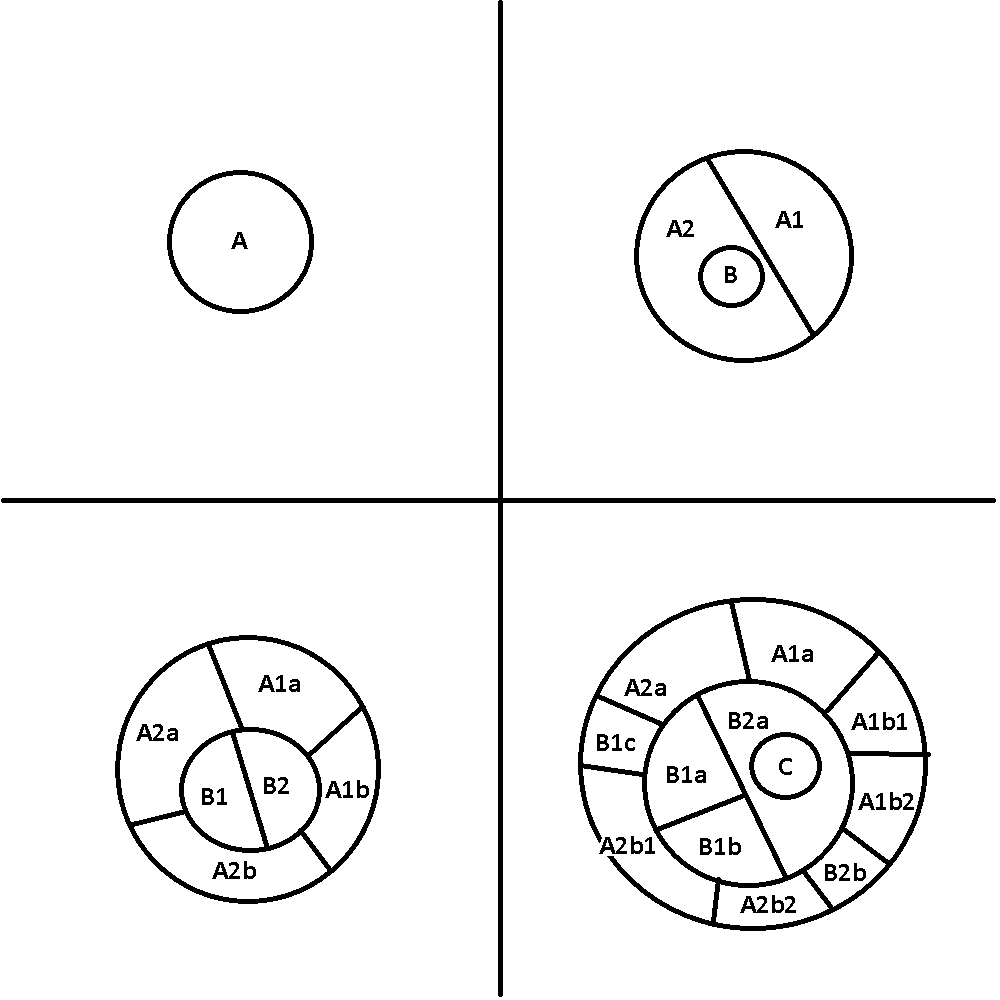
The way I see it, great genetic diversity within a population in a given area indicates that that area is a peripheral area rather than a core area. It seems to me that genetic innovations usually occur in core areas and subsequently expand outwards from that core area. This causes all previous genetic groups to move outwards. This results in the genetic innovation dominating the core area, while the periphery becomes increasingly populated by a diverse assortment of genetic groups that had previously existed.

[The following text added on September 29, 2021]

{The observations in the previous two paragraphs relate particularly to the movements of Y-DNA haplogroups; they are not valid with respect to the distribution of mtDNA haplogroups. The reason for this is simply the inherent natural difference between men and women with respect to territoriality.

Males are naturally inclined to expel all unrelated males from their territories, thereby tending to eliminate the possibility of Y-DNA diversity within their territories, and this is just as true on the level of entire haplogroups as on more localized levels (e.g. clans). On the other hand, females are not so inclined to eliminate other mtDNA haplogroups from their territories, thereby allowing for the accumulation of mtDNA diversity.

The natural male propensity to enforce territoriality necessarily means that the existence of Y-DNA diversity in a region must indicate a peripheral area rather than a core area.}

Here is a diagram that attempts to demonstrate the way I see this.

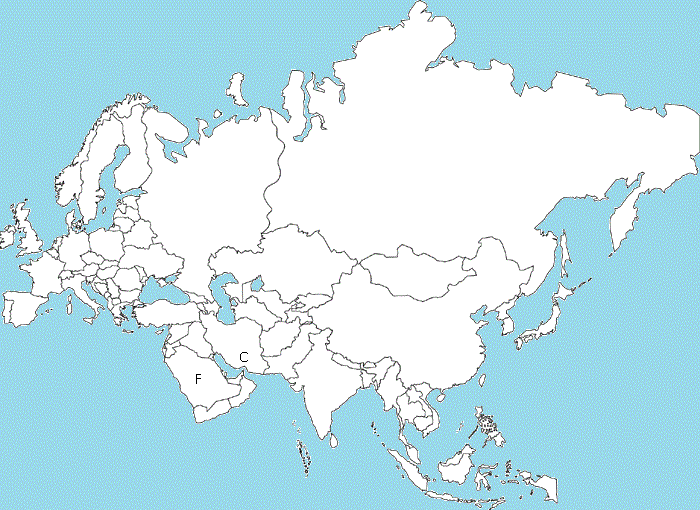
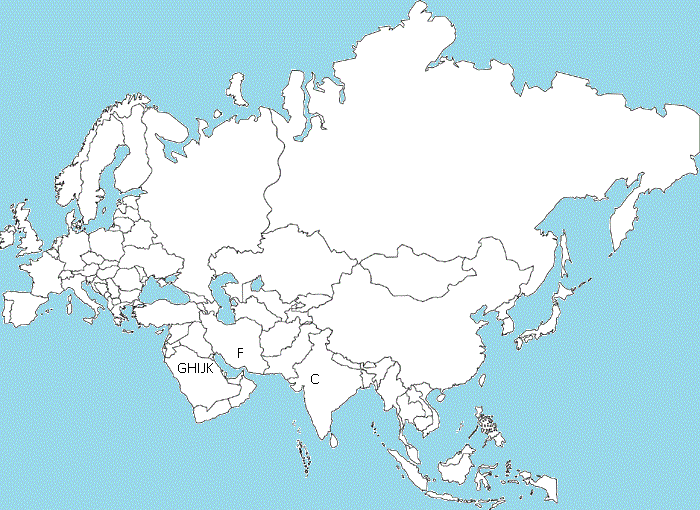
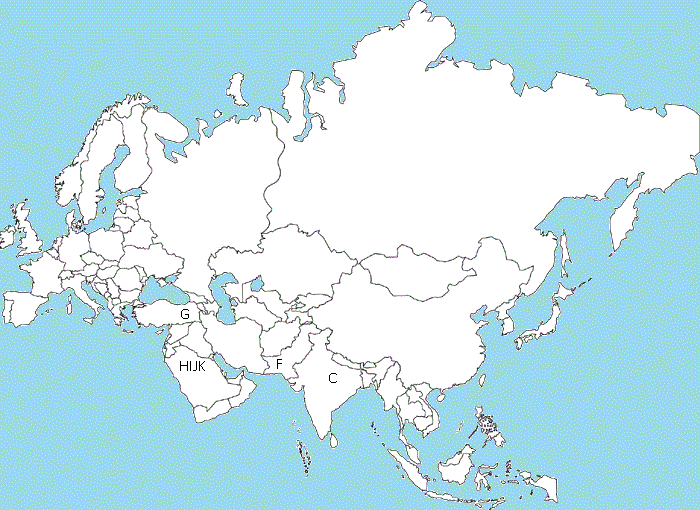
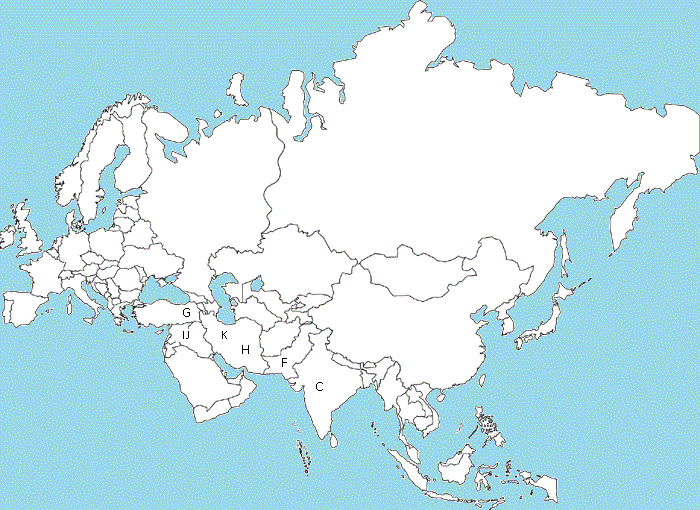
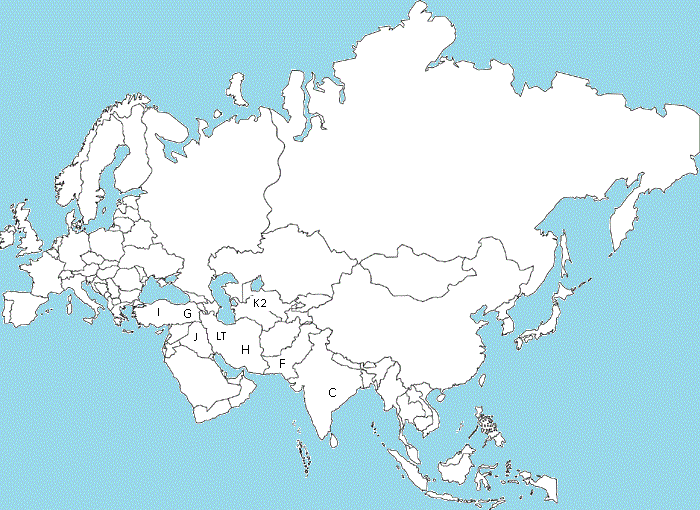
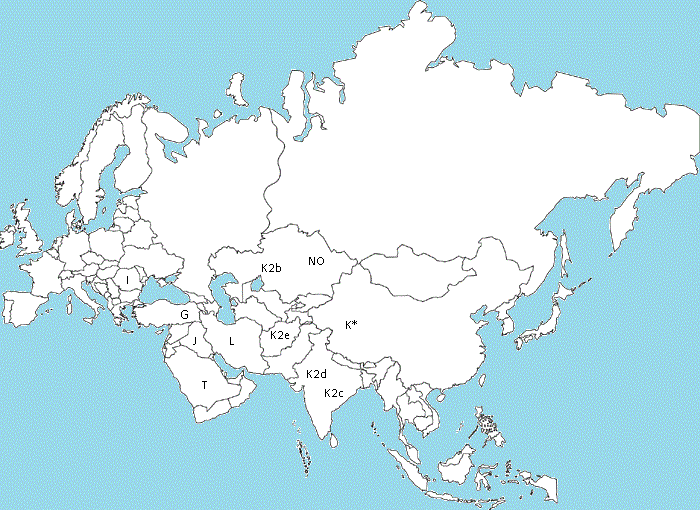
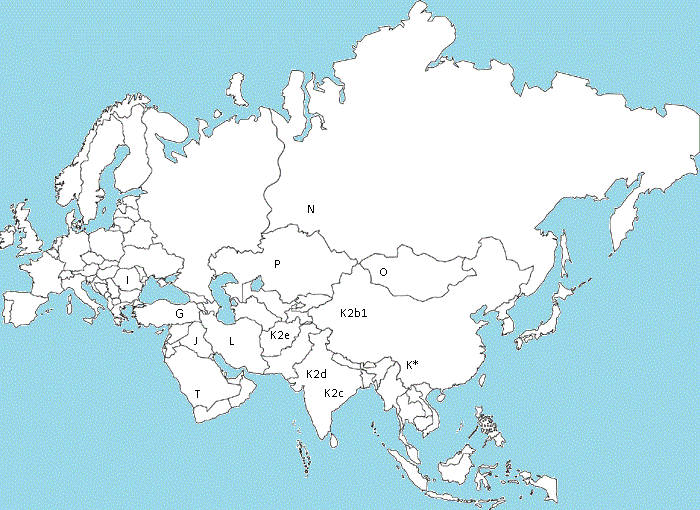
This being said, here are some maps that show how I see the development and movements of the Y-DNA haplogroups in Eurasia.

The following 11 maps represent an attempt at showing the origins and movements of Y-DNA haplogroups in Eurasia. I must stress that these maps are largely my own guesswork. I should also add that Wikipedia was practically the only source of information that I used.

Please note that only the main center of each haplogroup is generally indicated and that expansions from these main centers generally are not indicated.

Also note that haplogroups C, F and H are no longer shown after map 7.

I have attempted to guess approximate dates for these maps. The guess for the first map is approximately 80000 years ago and the guess for the last map is approximately 30000 years ago, the maps in between being at approximately 5000-year intervals.

c80000 BC
c75000 BC
c70000 BC
c65000 BC
c60000 BC
c55000 BC
c50000 BC
c45000 BC
c40000 BC
c35000 BC
c30000 BC

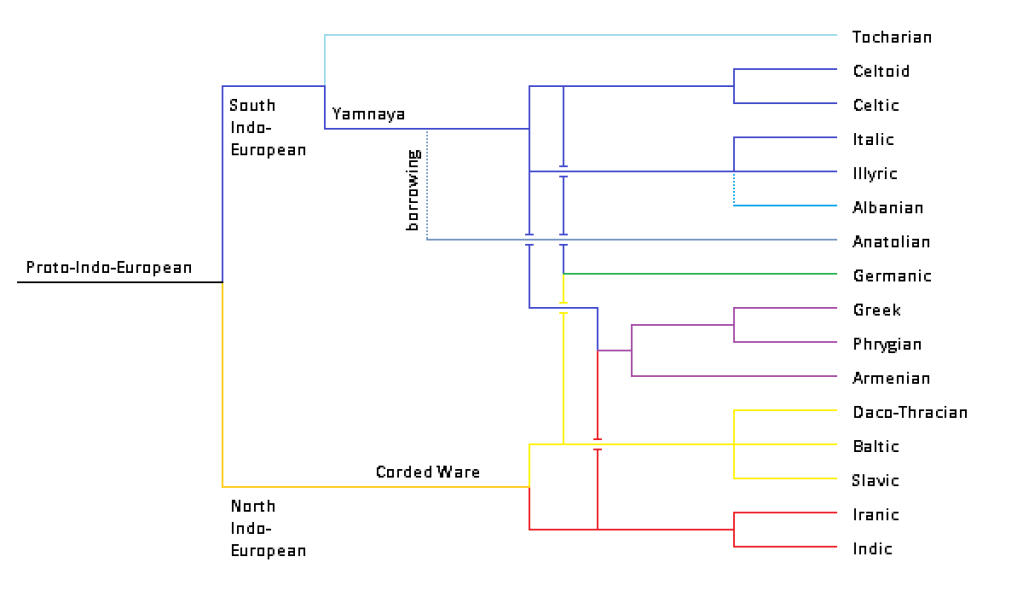
A Cladogram of the Indo-European Language Groups

The cladogram below attempts to show the relationships between the various branches of the Indo-European language family. The relationships shown in this cladogram should be compared with the geographic distributions of Indo-European language groupings between 3000 BCE and 1000 BCE shown on the following page: https://vellaunos.ca/2021/03/24/the-movements-and-expansions-of-indo-european-language-groups/

April 13, 2022 : I have produced a modified version of the cladogram to reflect my current view on the Illyrian & Albanian languages – see https://vellaunos.ca/2022/01/30/illyrians-and-albanians/ I have decided to keep the older version of the cladogram which appears below the newer version.

(Right-click and choose “Open image in new tab” to view full images.)

April 13, 2022 version
Older version

The Movements and Expansions of Indo-European Language Groups

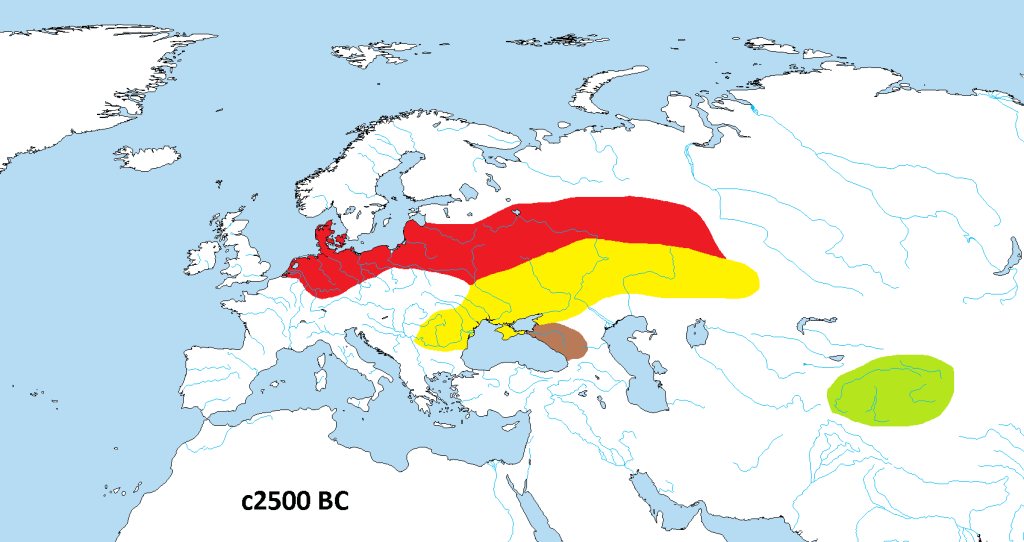
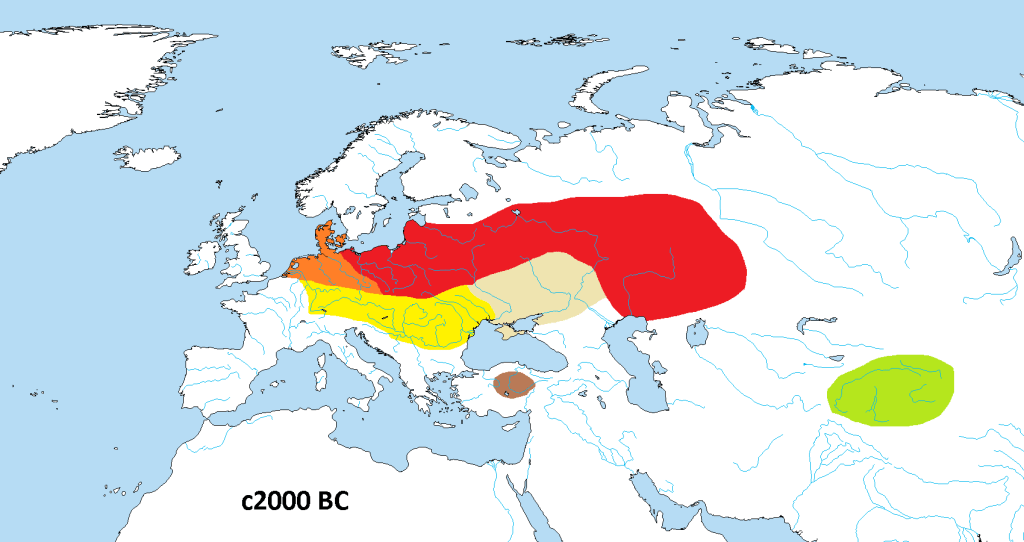
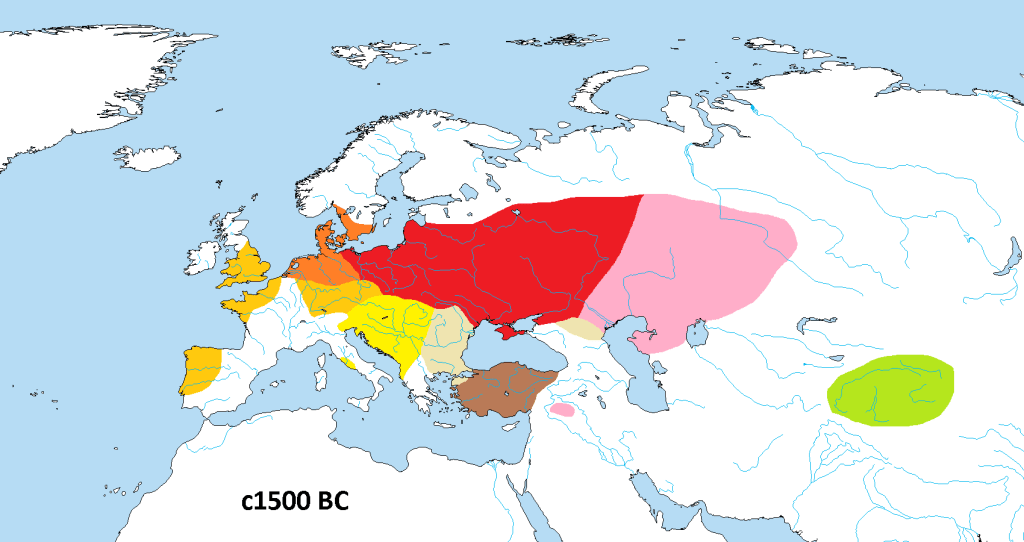
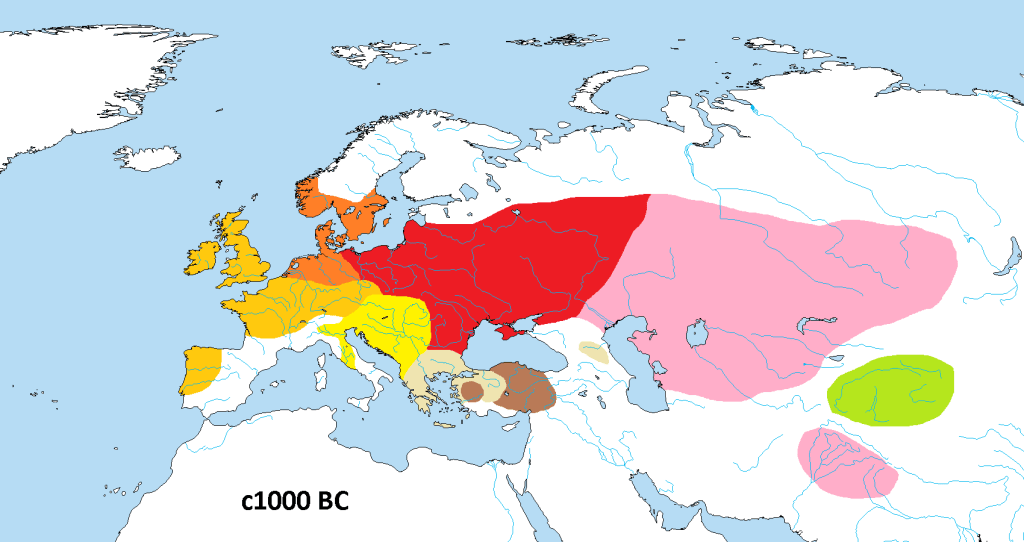
Below are five maps which attempt to show the linguistic territories of the main divisions of the Indo-European language family around 3000 BC, 2500 BC, 2000 BC, 1500 BC and 1000 BC.

Please note that the extents of these linguistic territories are largely speculative. Also note that these linguistic territories do not necessarily correspond with the territories of identifiable archaeological cultures.

In my view, the Proto-Indo-European language existed before 5000 BC in the forested areas west of the Ural Mountains. This Proto-Indo-European language split into two dialects as it expanded southwards into the steppe zone sometime around 5000 BC. I call these two dialects North Indo-European (or Forest Indo-European) and South Indo-European (or Steppe Indo-European).

In red is the linguistic territory of North Indo-European (or Forest Indo-European). The descendants of North Indo-European are Balto-Slavic and Indo-Iranian. In my view, the Cimmerian and Daco-Thracian languages were southern extensions of the Balto-Slavic group, while the Scythian language of course belongs to the Indo-Iranian group.

In the last two maps below (1500 BC & 1000 BC), the Indo-Iranian dialect of North Indo-European (in pink) is distinguished from the Balto-Slavic dialect (in red).

In yellow is the linguistic territory of South Indo-European (or Steppe Indo-European). The descendants of South Indo-European are Celtic (including Celtoid), Italo-Illyric, Greco-Phrygian and Tocharian. This last group was an early offshoot from South Indo-European and soon diverged greatly from it; for this reason, a light green color is used for Tocharian on the four maps after the first one.

[February 16, 2022 – I have recently come to believe that Illyric was neither part of an Italo-Illyric branch, nor even part of the larger grouping that I define here as South Indo-European – see https://vellaunos.ca/2022/01/30/illyrians-and-albanians/ ]

It is my opinion that the Yamnaya Culture and its predecessors were not speakers of a unified Proto-Indo-European language. The language of the Yamnaya Culture was the southern dialect of Proto-Indo-European from which the Celtic, Italo-Illyric and Greco-Phrygian languages developed.

As for the northern dialect of Proto-Indo-European, this was probably the language of the Comb Ceramic (or Pit-Comb Ware) Culture. It was also the language of the Corded Ware Culture and of its easterly extensions (Middle Dnieper, Fatyanovo-Balanovo).

In brown is the linguistic territory of Anatolian, which in my view is the result of the (partial) adoption of South Indo-European by the non-Indo-European speakers north of the Caucasus who had produced the Maykop Culture.

In beige is the territory of the language that became Greek and Phrygian. This language in my view resulted from a fusion of the eastern dialect of North Indo-European (i.e. Pre-Proto-Indo-Iranian) with the South Indo-European language that was still spoken on the Pontic Steppe after the Yamnaya period. (This would have occurred before the centum-satem split.)

(Armenian is probably an offshoot of this language group, moving southwards over the Caucasus into historic Armenian territory while Greco-Phrygian moved westwards through the Pontic steppe.)

In the last two maps below (1500 BC & 1000 BC), the dialectal division between Italo-Illyric (in yellow) and Celtic (in light orange) is shown.

In orange is the linguistic territory of Germanic, which in my view is the result of a fusion of North Indo-European (particularly Pre-Proto-Baltic) and South Indo-European (particularly Pre-Proto-Celtic).

I have created a cladogram of the Indo-European language family: https://vellaunos.ca/2021/03/24/a-cladogram-of-the-indo-european-language-groups/