SA KOMBROGIJA GALLAKA
THE GAULISH FEDERATION
LA FÉDÉRATION GAULOISE
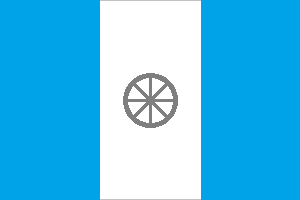
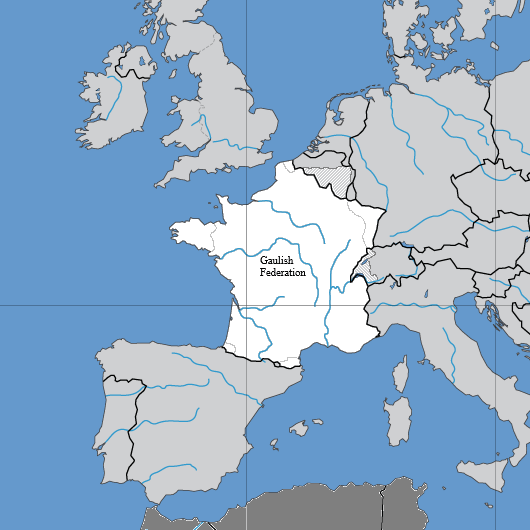
The Gaulish Federation is a federation of Gaulish tribes that replaced the French Republic after the fall of civilization. Its full name is Federation of Independent New Gaulish Tribes, but it may simply be called Gaul. It may be considered a successor of the state commonly known as France, but it is more importantly the true resurrection of the Gaulish Nation.
The Gaulish Federation does not include all the territories that were part of the French Republic. Corsica and all overseas territories such as French Guiana, French Polynesia and New Caledonia have been abandoned.
On the other hand, the Gaulish Federation claims the following territories: the Francophone part of Belgium known as Wallonia, the Francophone part of Switzerland known as Romandy (French Suisse romande), and the Channel Islands (Jersey and Guernsey).
Some territories of the former French Republic that have significant non-French populations are recognized as fully autonomous dependencies of the Gaulish Federation. These include the historically Breton-speaking territory of Britanny, consisting of the three former French departments of Côtes-d’Armor, Finistère and Morbihan; the historically Germanic-speaking territory of Alsace-Lorraine which includes the former French departments of Moselle, Bas-Rhin and Haut-Rhin; the French Basque Country in the western half of the former French department of Pyrénées-Atlantiques; the historically Catalan-speaking Roussillon consisting of the former French department of Pyrénées-Orientales; and the historically Flemish-speaking northernmost part of the former French department of Nord.
The Gaulish Federation is prepared to fully relinquish any of these autonomous dependencies if their populations request it.
All administrative divisions of the French Republic ceased to exist with the collapse of civilization. The regions and departments have been replaced by tribal countries, the arrondissements and cantons have been replaced by local districts, and the communes have been replaced by villages.
The Gaulish Federation consists of 60 tribal countries, each of which is a sovereign country with its own government. Each tribal country is the territory of an original Gaulish tribe that has been revived and reestablished. Most tribal countries are tribal kingdoms with hereditary kings (rîgas, singular rîxs) but some are tribal republics headed by vergobretas appointed by the government.
The territories of these tribal countries largely correspond with the territories of the Roman Catholic dioceses that existed before the French Revolution, which in turn largely corresponded with the civitates that were defined by the Roman Empire during the first few centuries of the Common Era, which in turn corresponded largely with the tribal territories that existed before the Roman conquest of Gaul by Julius Caesar between 58 and 51 BCE.
The names of the tribal countries (and of their respective tribes) are revivals of the original Gaulish tribal names, these often being reflected in the names of the traditional French provinces and countries. For example, the historic province of Poitou that largely continued the territory of the Pictones has essentially been restored as the tribal country called Pixtonija, this being the tribal country of the Pixtonas, and the historic province of Berry that largely continued the territory of the Bituriges has essentially been restored as the tribal country called Biturîgija, the tribal country of the Biturîgas.
Original Gaulish place names have also been revived; for example, Poitiers is called Lemona, Bourges is called Avarika, Bordeaux is called Burdigala, Lyon is called Lugudûna, and Paris is called Lutetia. Likewise, names of geographical features have been reverted to their original Gaulish forms: the Loire river is called Liger, the Garonne river is called Garumna, the Rhône river is called Rodana, and the Cévennes mountains are called Kebennas.
A High Druid-King (Vor-Druid-Rîxs) is head of the Gaulish Federation, his official title being “High Druid-King of the Gaulish Federation”, although he may also be referred to as “High Druid-King of the Gauls”. The High Druid-King of the Gaulish Federation is elected by the Federal Druidic Council from one of their own.
A First Minister (Tuitsaka Kintama) is also elected by the Federal Druidic Council from one of their own. The functions of the First Minister largely correspond with those typically associated with prime ministers.
The first and current High Druid-King uses the name Vellaunos as his regnal name, this being the name of a Celtic deity. Future High Druid-Kings of the Gauls may use other deity names as their regnal names, including Belinos, Lugus, Esus, Kernunnos, Taranus, Toutatis, Sucellos, etc.
The capital of the Gaulish Federation is Vellaunadûna (Vellaunodūnon in Old Gaulish), this being identified with Château-Landon in the Gâtinais. The residences of the High Druid-King, of the First Minister and of all other members of the Federal Druidic Council are in Vellaunadûna, and the Federal Parliament Building is also located in Vellaunadûna.
All governmental and political institutions, organizations and systems of the French Republic ceased to exist when civilization collapsed. This includes the civilized concept of electoral democracy; no leader or member of any government in the Gaulish Federation is elected by the people except for the chiefs of the villages who are in fact elected by the people of their villages.
A Federal Druidic Council (Komarelja Druidaka Kombrogjaka) consisting of 60 Druids, one from each constituent country of the Federation, acts as the governing body of the Gaulish Federation. It may be considered the Gaulish Senate, and has legislative, executive and judicial power. The Federal Druidic Council elects its own members.
A Federal Gaulish Parliament (Datla Kombrogjaka) is convened four times a year, on the mid-points between the solstices and equinoxes, to deliberate on matters of federal importance. The heads of all 60 constituent countries of the Gaulish Federation attend these parliaments. The Federal Gaulish Parliaments produce resolutions that are passed to the Federal Druidic Council for their consideration.
The Gaulish Federation is not part of any international organization of any kind, such as the United Nations, the European Union or NATO.
The Gaulish Federation has undertaken a long-term project of decivilization. This means the gradual removal and elimination of everything that belongs particularly to the civilized way of life, including everything from agriculture and animal husbandry, to money and business, to modern science and technology. The aim is to restore a truly natural and truly real way of life throughout the territory of the Gaulish Federation.
The most important aspect of this decivilizing process is the elimination of all civilized systems, including civilized economic systems, civilized political systems, civilized legal systems and civilized educational systems. Also important is the eradication of all civilized art, culture, entertainment, media and religion. Finally, there is the removal of all civilized infrastructure, including modern transportation systems, modern energy systems, modern computer systems, etc.
All business and modern industry have been abolished, including all domestic companies as well as foreign companies. The use of money in any form whatsoever is strictly forbidden in the Gaulish Federation and all profit-seeking of any kind is categorically prohibited. All forms of slavery, servitude and employment are strictly forbidden in the Gaulish Federation.
All foreign and international institutions and organizations have been expelled from Gaul. Every institution and organization in the Gaulish Federation is truly a Gaulish institution or organization that exists for the sake of the interests of the Gaulish Nation.
Intensive agriculture (i.e. industrial agriculture) has been completely eliminated. Modern agricultural methods and machinery are forbidden. Cereal crops have been replaced by other crops including vegetables, legumes, fruits and nuts. Dairy farming has largely been eliminated. All agriculture in the Gaulish Federation is limited to the local needs of families and villages. Also, a large amount of territory in the Gaulish Federation has been allowed to revert to wilderness, and the reintroduction of native species of wildlife is encouraged, as well as the elimination of invasive and introduced species.
The establishment of the Gaulish Federation essentially means the reversal of all the civilized developments of the past two millennia, from the Roman Conquest of Gaul to the French Revolution and Industrialization, and beyond to the present day. More particularly, it brings an end to the legacy of the imposition of Roman Civilization over Gaul, as well as the legacy of the domination of Christian Civilization over Gaul.
The establishment of the Gaulish Federation also effectively means the end of over two thousand years of foreign rule over Gaul, including not only Roman rule and Frankish rule, but also French rule – even France has always been a foreign occupier of Gaul, both as a kingdom and as a republic. Only the Gaulish Federation truly means the restoration of Gaulish rule over Gaul.
The population of the Gaulish Federation consists almost entirely of folks that were established on the territories of the Gaulish Federation before the Modern Period. All other peoples that settled in France during the Modern Period have been expelled. Immigration is restricted to people whose ancestry is exclusively from western Europe (the British Isles, France, the Low Countries, Germany, Switzerland, Austria, Scandinavia, Spain, Portugal, Italy). All Jews are strictly banned.
The total population of the Gaulish Federation is approximately 6 million, this being close to the population of Gaul before the Roman Conquest. This represents a drastic reduction from the nearly 70 million that inhabited the territories of the French Republic that would become part of the Gaulish Federation.
The three main reasons for this reduction are the expulsion of millions of peoples that were not historically native to the territories of the Gaulish Federation, the emigration of millions of native French citizens who were not sympathetic to the Gaulish Federation, and the inability of millions of people to survive the removal and elimination of civilized amenities, services and supports. In these three ways, the Gaulish Federation has successfully rid itself of all foreign invaders, all degenerates and deviants, and all wicked demons, and is effectively left with only the best people – a most undeniably desirable result.
The official language of the Gaulish Federation is New Gaulish (Novija Gallaka), a constructed Celtic language based partly on evidence of Gaulish (inscriptions, Roman and Greek attestations, survivals in Gallo-Romance) and partly on comparisons with Brittonic languages (such as Welsh and Breton) and Gaelic languages (especially Old Irish).
Alongside the official form of New Gaulish which is quite conservative, a more popular form of New Gaulish is commonly used. This more popular form of New Gaulish differs significantly from official New Gaulish phonologically and grammatically. For example, official New Gaulish Novija Gallaka is Nœvizh Gallag in popular New Gaulish.
Breton, Alsatian, Franconian, Flemish, Basque and Catalan are recognized in the autonomous dependencies in which they are spoken, as well as all Gallo-Romance languages that have historically been spoken throughout the territories of the Gaulish Federation (e.g. French, Poitevin, Picard, Walloon, Occitan, Provençal), and every tribal state is free to choose which language to use as its own tribal official language.
The official religion of the Gaulish Federation is True Druidism, this being a rational and natural religious philosophy rather than an irrational and unnatural religious faith. Any superstitious, supernatural and magical elements that may have existed in Ancient Druidism or Irish Druidism have been completely disregarded in True Druidism. All religions apart from True Druidism are strictly prohibited, as well as all religious or spiritual superstitions, illusions and deceptions generally. In particular, the religious disorders known as Christianity, Judaism and Islam have been totally eradicated from Gaul.
The Gaulish Federation officially promotes an exclusively native Gaulish culture, this hypothetically being a restoration of the culture of the Ancient Celts but without any fantastic, imaginary or illusory elements; this necessarily means the exclusion of most Irish, Welsh and Arthurian myths. All elements from foreign cultures are categorically forbidden but some elements of traditional French culture may be accepted. All musical and artistic works that contain Jewish or Christian elements are especially prohibited and have been completely eliminated, and all literature that contains Jewish and Christian elements has also been eliminated altogether. Likewise, all music, art and literature that is a product of modern civilized culture has been entirely obliterated.
The Gaulish Federation endorses a critical revaluation of all Gaulish and French history, with the understanding that a proper view of history is of crucial importance to the Gaulish peoples. Every aspect of history is subjected to this critical revaluation, including political history, military history, religious history, social history, cultural history, economic history, scientific history and technological history.
The Roman Conquest is properly understood as a brutal and genocidal event; the conquest of Saxony by Charlemagne is viewed similarly. Roman Rule over Gaul is understood as nothing short of a strict authoritarian regime. The establishment of the Christian Disorder (i.e. Christianity) in Gaul is understood as the further subjugation of Gaul to fanatical totalitarianism. And the French Revolution is also recognized as an expression of fanatical totalitarianism but of a liberal and progressive variety.
In the perspective of this historical revaluation, the greatest of all historical figures are the Gaulish heroes and martyrs who fought and died to save Gaul during the Roman Conquest, including Gaulish leaders such as Ambiorix, Dumnorix and Vercingetorix. And whereas the French in the late 19th century began to speak of themselves as descendants of the Gauls (“nos ancêtres les Gaulois”), the peoples of the Gaulish Federation understand that they themselves truly are the Gauls.
GAULISH FEDERATION FACTSHEET
Official name: Federation of Independent New Gaulish Tribes
Capital: Vellaunadûna (formerly Château-Landon)
Total Area: 535 000 km2 (206 000 sq mi) (area of Metropolitan France minus Corsica)
Subdivisions: 60 tribal countries, further subdivided into local districts; 5 autonomous dependencies
Population: approximately 6 million (Urban 0%, Rural 100%)
Population density: approximately 11.2/km2 (29.1/sq mi)
Migrants: negligible (mainly English, Dutch, German, Italian and Spanish)
Official language: New Gaulish
Other languages: Langues d’Oïl (incl. French), Occitan, Arpitan, Breton, Basque, Catalan, Alsatian, Flemish
Race: 100% White European (particularly Northwest European)
Ethnic groups (i.e. nationalities): Gauls, Bretons, Basques, Catalans, Alsatians, Flemings
Government type: Tribal Federation with Druidic Monarchy
Senate: Druidic Council (60 members, one Druid from each Tribal country)
Legislature: Federal Parliament (60 members, one from each Tribal country)
Head of state: High Druid-King Vellaunos I
International organizations: none
Education: no mandatory public education (all education is optional and private)
Literacy: less than 5%
Religion: 100% True Druidism (all other religions are forbidden)
Economy: traditional non-civilized economy, non-monetary, no businesses
Gross Domestic Product: not applicable
Unemployment: not applicable
Currency: none
Life expectancy: approximately 60 years
Age distribution: 0-14 – 40%, 15-29 – 30%, 30-44 – 20%, 45-59 – 10%, 60+ < 1%
Birth rate: approx. 30/1000 people
Death rate: approx. 25/1000 people
Infant mortality: approximately 20 in 1000 live births

