Indo-European Movements

[The following may be compared with this page that I posted five years ago: https://vellaunos.ca/2021/03/24/the-movements-and-expansions-of-indo-european-language-groups/ ]

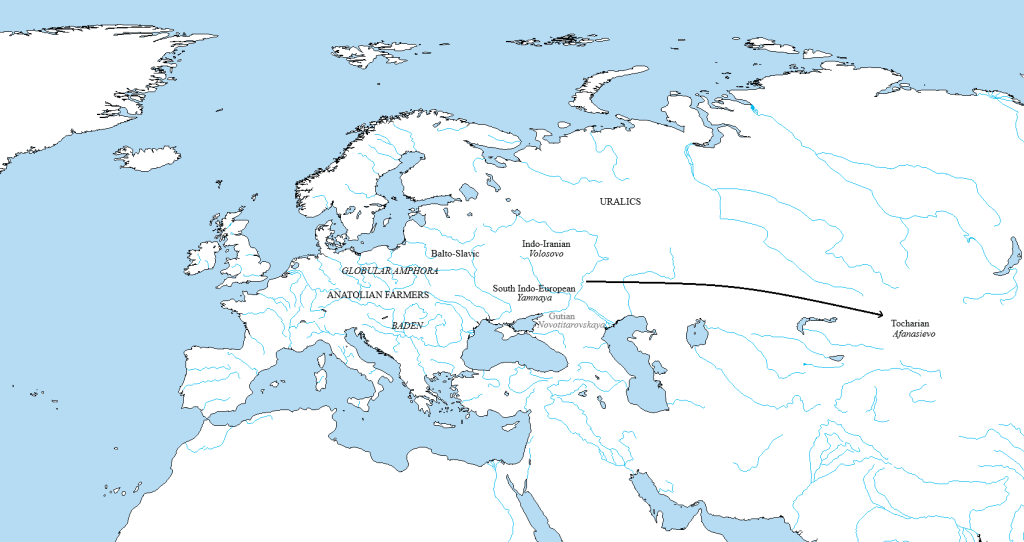
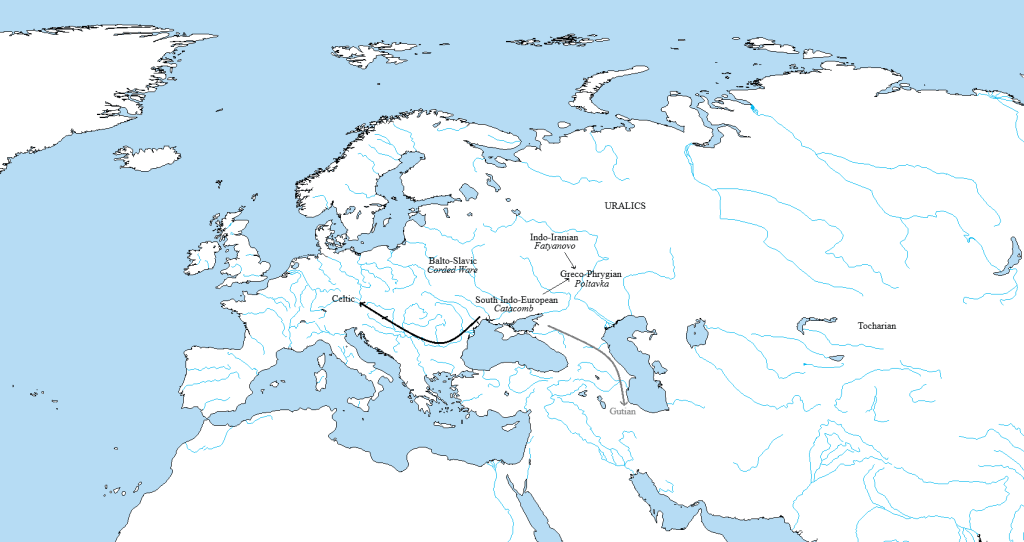
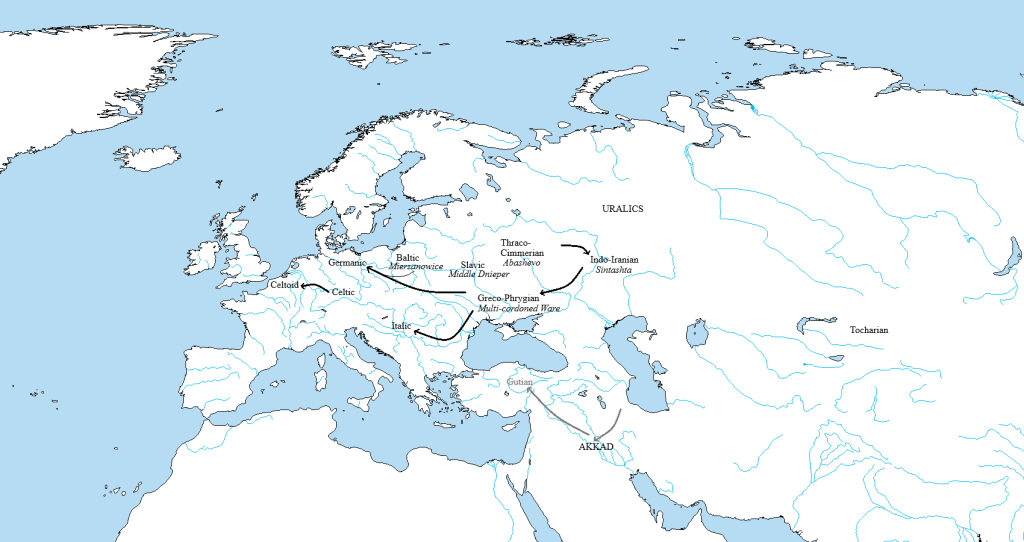
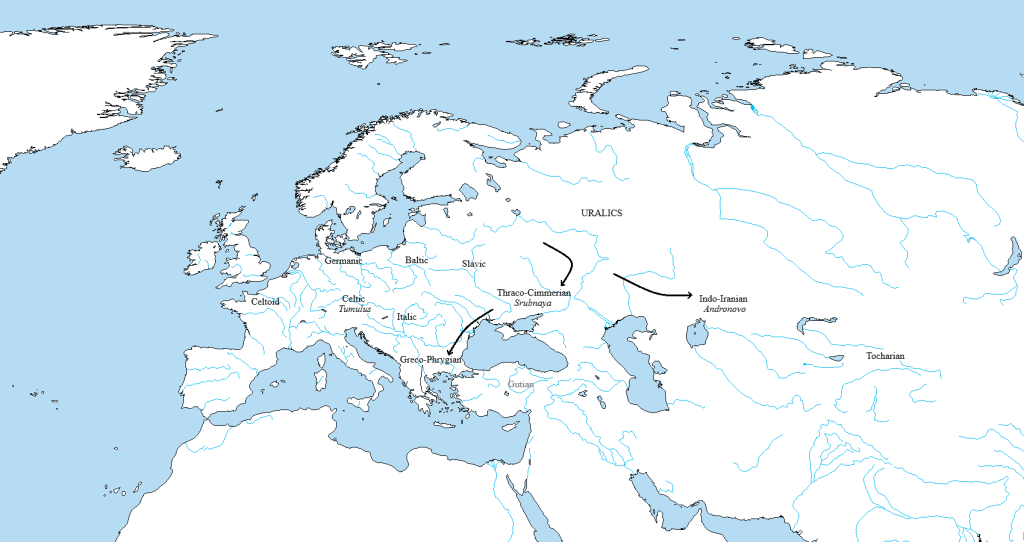
The seven maps below are an attempt at briefly showing the movements of the various Indo-European groups in prehistory. Archaeological cultures associated with some Indo-European groups are shown in italics. Non-Indo-European groups are also indicated in CAPITALS along with some of their archaeological cultures in ITALIC CAPITALS.

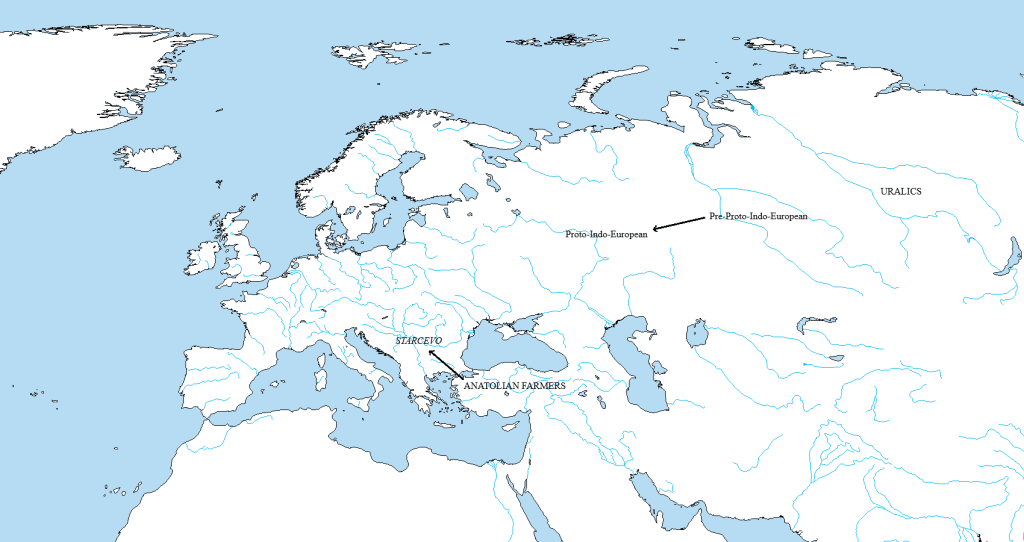
Map 1 – 6000 BC

The Pre-Proto-Indo-Europeans lived in the forest zone east of the Ural Mountains. At some time before 5000 BC, part of this population migrated westwards through the Urals into the forest zone of what is now eastern Russia, this being the Proto-Indo-Europeans. These movements may have been precipitated by westward movements of Uralic peoples from the east. During this period, Anatolian Farmers (usually called “Early European Farmers”) begin to colonize southeastern Europe, eventually producing the Starcevo-Koros-Cris Culture [c6200 to c4500 BCE] of the central Balkans.

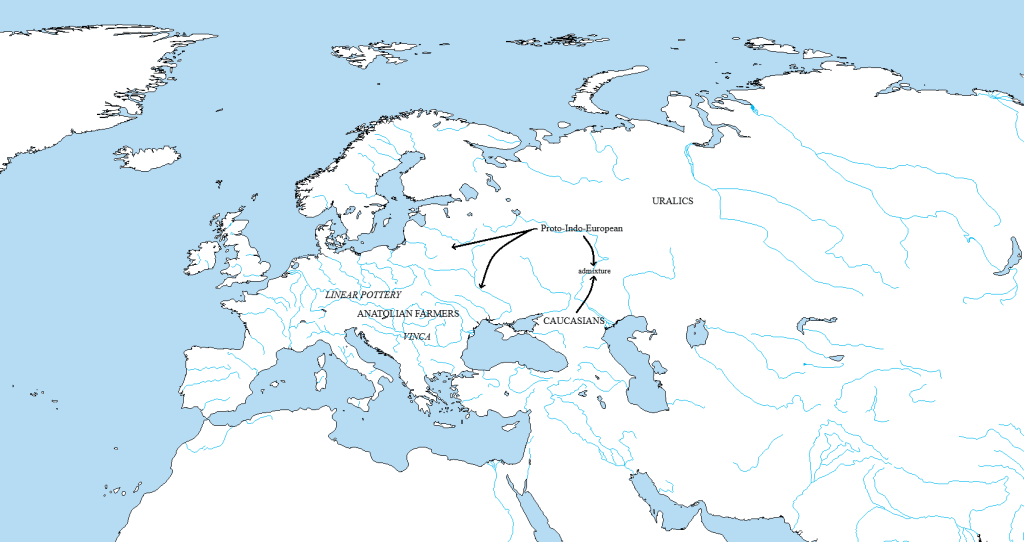
Map 2 – 5000 BC

The Proto-Indo-Europeans split into two dialect areas. The North Indo-Europeans expand westwards through the forest zone towards the Baltic Sea. Meanwhile, the South Indo-Europeans venture southwards into the steppe zone along the Volga River [Samara Culture c5000 BCE]. The South Indo-Europeans contact the Caucasians of this area, leading to admixture as well as the acquisition of agriculture. By this time, the Anatolian Farmer culture called the Linear Pottery Culture [c5500 to c4500 BCE] has developed from Starcevo and expanded through central Europe up to what is now eastern France, while the Anatolian Farmer Vinca Culture [c5400 to c4500 BCE] replaces the Starcevo Culture in the Central Balkans.

Map 3 – 4000 BC

The North Indo-Europeans inhabit the forest zone from the fringes of the Baltic to the Urals, maintaining a hunter-gatherer existence. Their main culture is the Comb Ceramic (or Pit-Comb Ware) Culture [c4200 to c2000 BCE]. The South Indo-Europeans expand westwards across the Pontic Steppe. Their cultures include the Khvalynsk Cuture [c4900 to c3500 BCE] and Repin Culture [c3900 to c3300 BCE]. During this period, the Anatolian Farmer culture called Cucuteni-Trypillia [c5800 to c3000 BCE] expands into the western part of the Pontic Steppe, while the Funnelbeaker Culture [c4300 to c2800 BCE] expands throughout northern Europe.

Map 4 – 3000 BC

The North Indo-Europeans split into two dialect groups: a western group which is the beginning of Balto-Slavic and an eastern group which is the beginning of Indo-Iranian (Volosovo Culture). The South Indo-Europeans have expanded to the foothills of the Carpathians, their culture being the Yamnaya Culture [c3300 to c2600 BCE]. Part of this population has migrated eastwards into the Altai region where the Afanasievo Culture [c3300 to c2500 BCE] eventually arises, this being considered to be the Tocharians. A group of Caucasians between the Yamnaya Culture and the Maykop Culture [c3700 to c3000 BCE] becomes Indo-Europeanized. Their culture is the Novotitarovskaya Culture [c3300 to c2700 BCE] and they are the beginning of the Gutians (who are usually misnamed the Anatolians). The Anatolian Farmer cultures of this period include the Globular Amphora Culture [c3400 to c2800 BCE] of northeastern Europe and the Baden Culture [c3600 to c2700 BCE] of the northern Balkans.

Map 5 – 2500 BC

The Corded Ware cultural complex [c3000 to c2350 BCE] spreads among the North Indo-Europeans, the Fatyanovo [c2900 to c2050 BCE] derivative of this developing among the Indo-Iranians. A mixture of South Indo-Europeans and Indo-Iranians in the Volga region produces the Poltavka Culture [c2800 to c2100 BCE], this being the original Greco-Phyrgian culture. The remaining South Indo-Europeans on the Pontic Steppe produce the Catacomb Culture [2500 to 1950 BCE]. The western part of the South Indo-Europeans has migrated into Central Europe via the Danube River, these being the earliest Celtic peoples. The Indo-Europoid Gutians have migrated to the Zagros Mountains via the north slope of the Caucasus Mountains and the west coast of the Caspian Sea.

Map 6 – 2000 BC

A part of the Indo-Iranians migrates eastwards across the Volga toward Central Asia, producing the Sintashta Culture [c2200 to c1900 BCE]. Those remaining in eastern Russia become the Thraco-Cimmerians of the Abashevo Culture [c2200 to c1850 BCE] (eventually the Srubnaya Culture on the Pontic Steppe [c1900 to c1200 BCE]). The Greco-Phrygian group migrates westwards onto the Pontic Steppe, their culture being the Multi-Cordoned Ware Culture [c2200 to c1750 BCE]. The South Indo-Europeans of the Pontic Steppe Catacomb Culture migrate westwards in two ways: one group migrates into the Hungarian region via the Danube River, this being the beginning of the Italic group; the other group migrates north of the Carpathians up to northern Europe, mixing with Baltic peoples along the way, this being the beginning of the Germanic group. Celtoid offshoots of the Celts have established themselves in the Atlantic regions (Armorican Tumulus Culture [c2200 to c1400 BCE], Wessex Culture [c2000 to c1400 BCE]). The Indo-Europoid Gutians have conquered and occupied Akkad for perhaps a century [c2200 to c2100 BCE], eventually being defeated and expelled, and ultimately ending up in Anatolia, becoming the Hittites, Lydians, etc (eventual Hittite retaliation on Babylon by Mursili I in 1595 BCE).

Map 7 – 1500 BC

The Indo-Iranians of the Andronovo Culture [c2000 to c1150 BCE] expand throughout Central Asia, eventually reaching modern Iran and northern India. The Thraco-Cimmerians of the Srubnaya Culture [c1900 to c1200 BCE] occupy the Pontic Steppe, displacing the Greco-Phrygians. These migrate into the eastern Balkans, a group of these invading and conquering the Helladic peoples of Greece, thereby producing the Mycenean Culture [c1750 to c1050 BCE]. The Germanic peoples of the Nordic Bronze Age [c1700 to c500 BCE] expand northwards into Scandinavia. The Italic peoples are established in the Pannonian Plain. The Celtic peoples of the Tumulus Culture [c1600 to c1200 BCE] are established in Central Europe, while the Celtoid peoples occupy the Atlantic periphery of northwestern Europe (north-western France, Great Britain, Ireland). The Indo-Europoid Gutians are established in Anatolia, one group of them forming the important Hittite Empire [c1650 to c1180 BCE].

Gallág Noevízh

The PDF below is a list of words of a conlang called Gallág Noevízh – “New Gaulish”. This represents an attempt at creating a modern version of Gaulish (rather than an absurd Irish version of Gaulish).

Please note that this wordlist is a work in progress – many new entries could eventually be added. And much of the etymological information has not yet been supplied…

Correspondences

The PDF below contains a random list of etymological correspondences between various words in Indo-European languages (i.e. cognates).

Many of these etymological correspondences aren’t found in Wiktionary and some of them differ considerably from those found in Wiktionary.

The True Story of the Celts

I recently watched a three-part documentary on Curiosity Stream called “Celts: The Untold Story”. Like most Curiosity Stream videos, it is very interesting and entertaining. But like many Curiosity Stream videos, particularly those dealing with prehistory, its fundamental message is simply wrong.

One of the major points of this documentary was that the Celts began with the Hallstatt Culture as a community of humble salt-traders in a tiny Alpine village. This to me is blatantly, even ridiculously, false. Proposing this effectively ignores the continuity of the successive cultures of Central Europe from the Bell Beaker period of the early Bronze Age through to the late Iron Age La Tène Culture. It’s also suspiciously reminiscent of the story of the Roman Empire originating from a single settlement called Rome that was allegedly founded by the twins Remus and Romulus.

By the way, this particular documentary isn’t the only one on Curiosity Stream that I’ve strongly disagreed with. There is also one about the Egtved Girl that has everything to do with promoting a feminist message of empowerment for young women rather than presenting the truth. As if a young woman could have traveled by herself over hundreds of miles through deep forests in prehistoric Europe without dying one way or another…

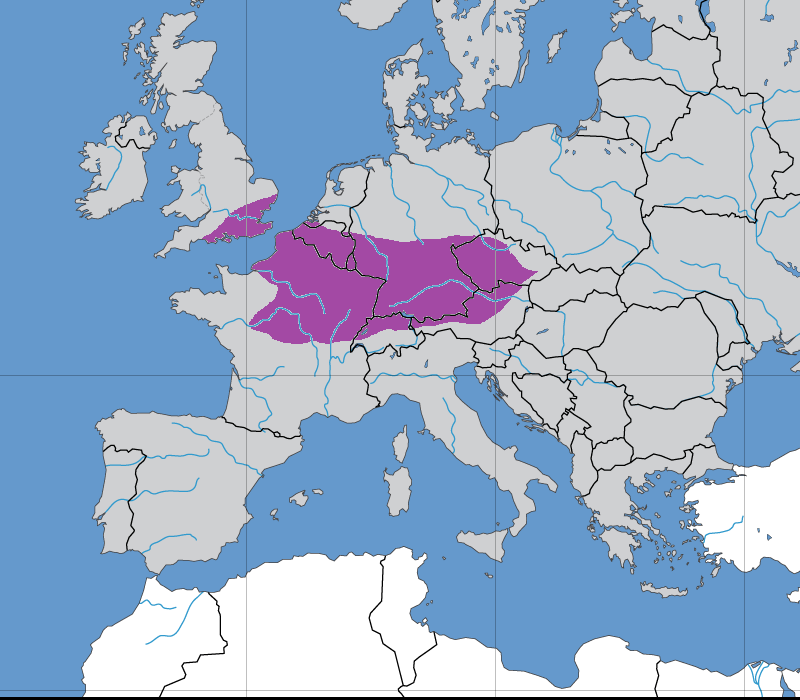
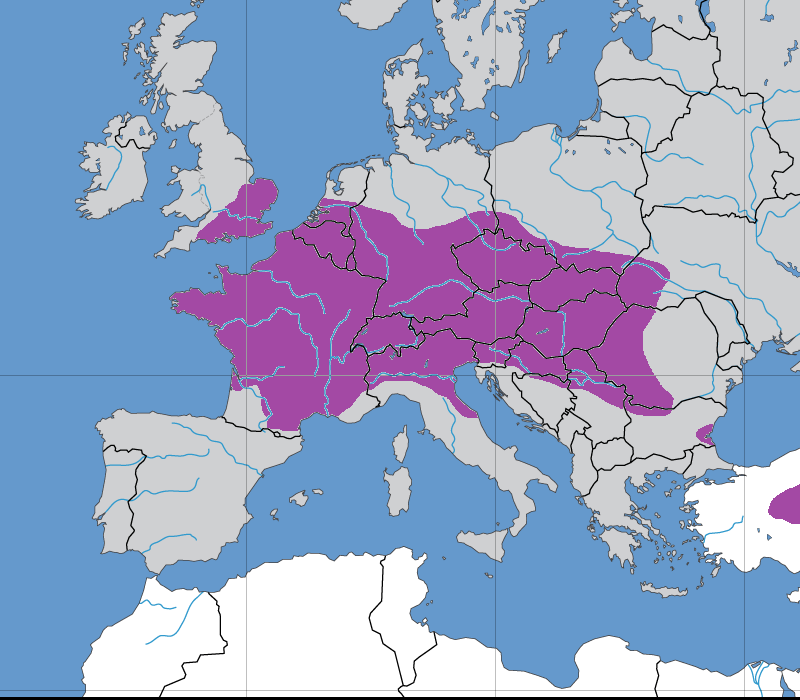
Watching this “Celts: The Untold Story” documentary prompted me to produce a series of maps that show the original settlement of the Yamnayan Proto-Celts in Central Europe and the areas of the subsequent Celtic cultures in Central Europe from the early Bronze Age to the late Iron Age. These maps do not show the spread of the Celtoid offshoot of the Celts into northwestern Europe (see https://vellaunos.ca/2021/03/26/celtic-and-celtoid/ ), nor do they show the migration of Celts into Iberia that produced the Celtiberians, nor do they show the area of the Lepontians in northern Italy (I still have my doubts about these being Celtic).

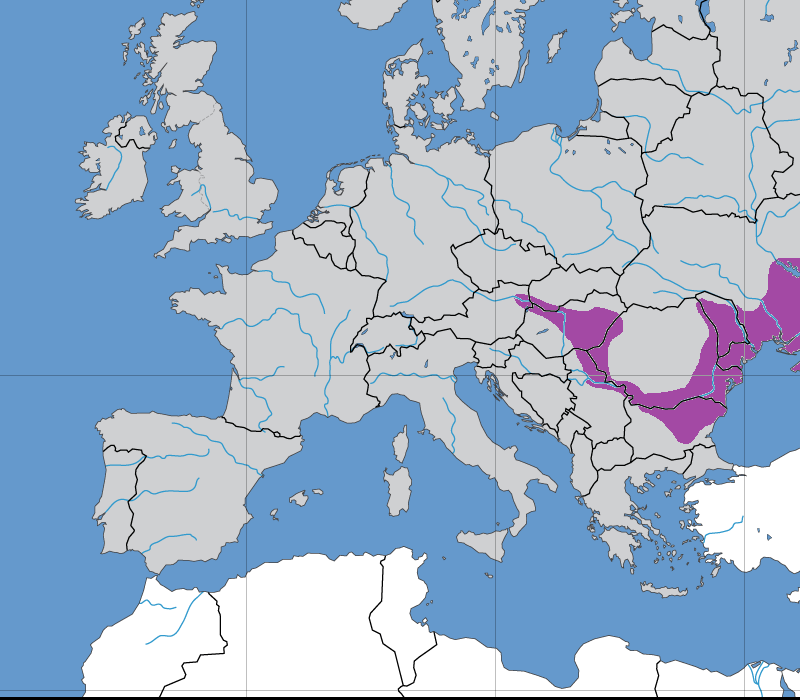
Map 1 – The expansions of the South Indo-European Yamnaya ancestors of the Celts from the Pontic Steppe along the Danube River valley – c3100 to c2600 BC

Map 2 – The extent of the Eastern Bell Beaker Culture representing the origin of the Celts – c2600 to c2300 BC – (The earliest Italic peoples, of South Indo-European Yamnaya origin and thus closely related to the earliest Celts, probably occupied the lower portion of the Danube valley at this time) (Further expansions to the northwest during this period eventually produced the Celtoid offshoot of the Celts)

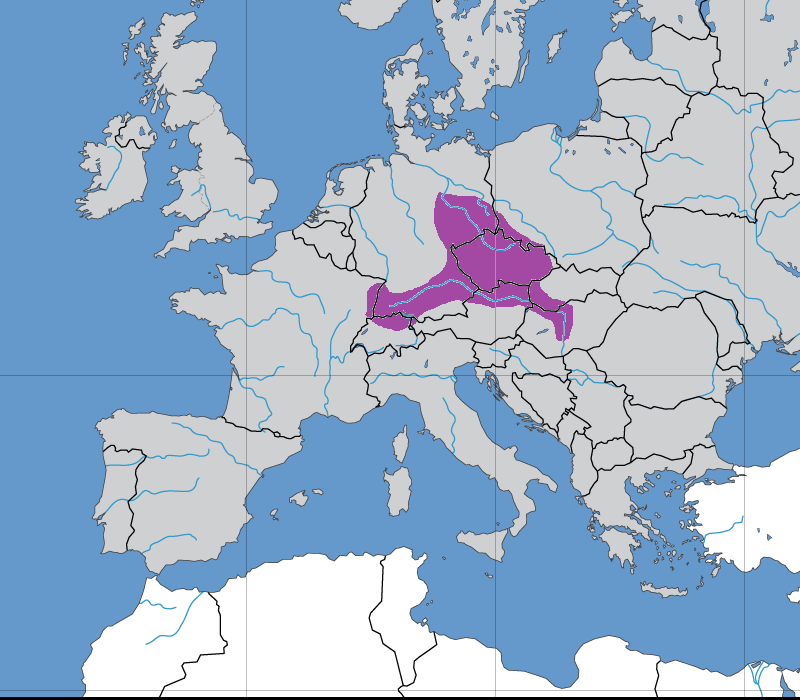
Map 3 – The extent of the Unetice Culture (north part) and the Danubian Early Bronze Age (south part) – c2300 to c1600 BC – (These two groups may represent diverging Celtic cultures, the Unetice Culture eventually disappearing and being partly absorbed by the Danubian Early Bronze Age, which spawned the later Celtic cultures of Central Europe)

Map 4 – The extent of the Celtic Tumulus Culture that developed from the Danubian Early Bronze Age, showing a loss of territory in the north but expansion both eastwards and westwards – c1600 to c1200 BC – (Celts expand into what is now eastern France)

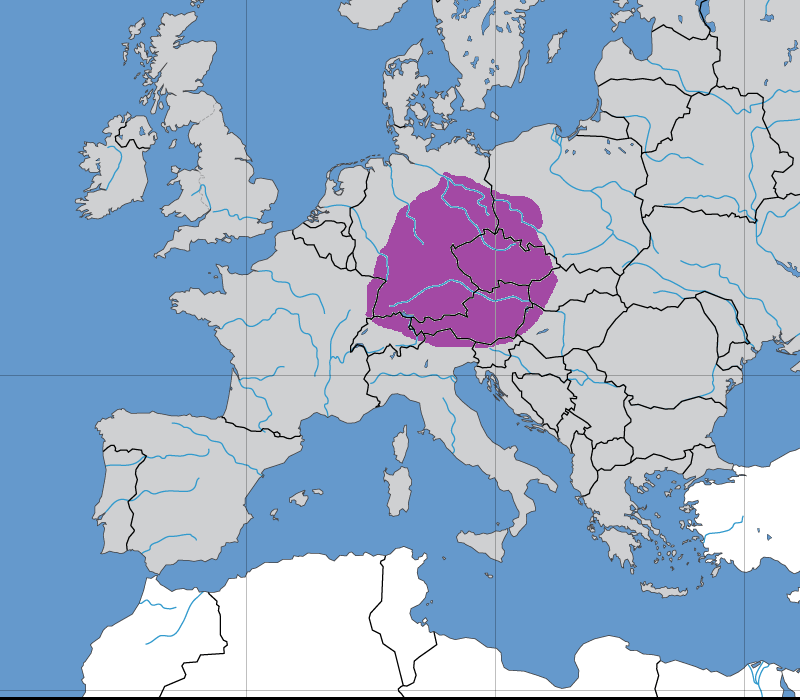
Map 5 – The extent of most of the Urnfield Culture without the Northwestern and Transdanubian areas (possibly West Germanic and P-Italic respectively) – c1300 to c750 BC – (Celtic begins to replace Celtoid in southeastern Britain (i.e. Brittonic) and expands further into what is now northern France) (The Celtoid offshoot of the Celts occupies most of the area of the Atlantic Bronze Age during this period)

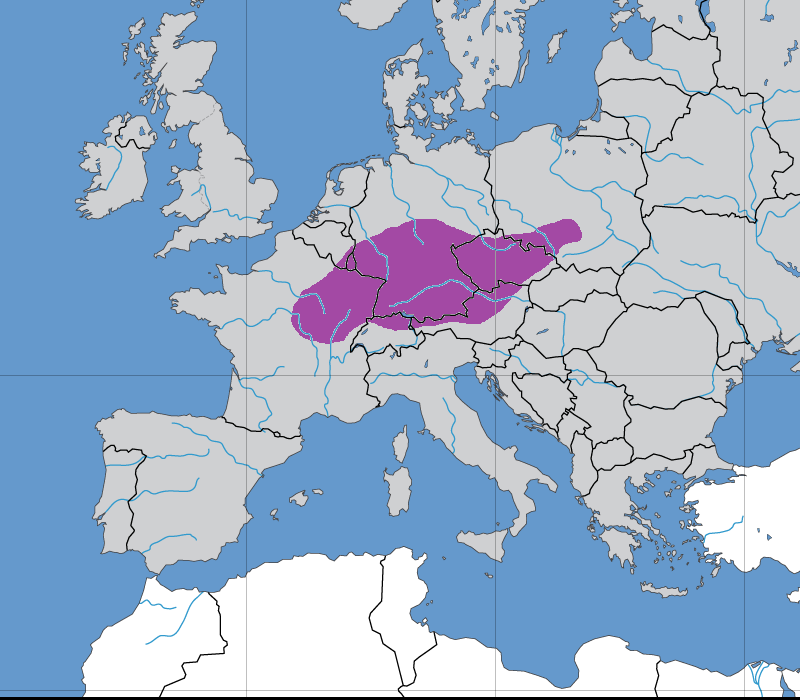
Map 6 – The extent of the Hallstatt Culture – c800 to c450 BC – (Celtic expands over most of what is now France, but without necessarily replacing Celtoid in most areas)

Map 7 – The maximum extent of the La Tène Culture – c450 to c1 BC – (Time of map c200 BC)

Grassmann’s Law in Greek

UPDATE December 03, 2022:

Soon after publishing the post below, the Ancient Greek word pēkhys ‘forearm’ came to my attention. This word is clearly from PIE *bheh2ghjus, other reflexes of which are Sanskrit bahu and Proto-Germanic *bōguz (which eventually became bough in English). If what I explained below were correct, the Greek word should have been **bēkhys rather than pēkhys. So my view of Grassmann’s law in Ancient Greek was obviously incorrect, and I now have to admit that Grassmann’s law evidently operated in Proto-Greek after the devoicing of aspirates rather than before it.

Yet, I still maintain the connections that I mentioned below between Ancient Greek agathos, Proto-Germanic *gōdaz and Proto-Celtic *dagos.  Because the g in Ancient Greek agathos was clearly original, I would now postulate an amended proto-form *h2gh2-dhos for this word (with a plain g instead of an aspirated g).  As for the Proto-Germanic cognate *gōdaz, I propose a proto-form *gh2eh2-dhos with metathesis of the first h2 laryngeal; the theory here is that gh2 would be treated as an aspirated g (i.e. gh), thereby resulting in g in Proto-Germanic. As for the Proto-Celtic *dagos, a proto-form *h2dhh2-gos might be suggested.

I have to admit that I’m not quite sure what to make of the Latin cognate honor that I proposed below. As for a possible Sanskrit connection, perhaps the verb root gāh– ‘dive, plunge, immerse oneself’ (past participle gāḍha) might be considered. Although there is no readily apparent semantic connection, this verb root could certainly come from *h2geh2-dh– (Wiktionary gives no etymological info for this verb root) and this would have the same form as the *h2gh2-dhos that I propose as a proto-form of Ancient Greek agathos.

Yes, it looks like a whole lot of etymological gymnastics, but I’m going with this for now…

ORIGINAL POST September 03, 2022:

In the course of my research for my Indo-European conlang called Wôks Teuteka (https://vellaunos.ca/2021/08/02/woks-teuteko/ ), I have recently established a connection between Greek agathos, Proto-Germanic *gōdaz (English good) and Proto-Celtic *dagos (Welsh da) among others. Here is the entry for the word gado in my Wôks Teuteka wordlist as it now stands:

gado (gados; gadôs) : good [< *h2ghh2-dhos; Lat honor ‘honor, esteem, dignity’ < h2gh(h2)-dho-nos (h2gh(h2)-dho-nes-); PrCelt *dagos (< *h2dhh2-ghos, metathesis of *h2ghh2-dhos (?)) > OIr dag-, Welsh da; *PrGmc *gōdaz (< *h2gheh2-dhos) > Eng good; Gr agathós ‘good, brave, noble, moral’ < *h2(e)ghh2-dhos; PrSlav *godьnъ > Russ godnyj ‘fit, suitable, valid, appropriate’] {for Lat ho– < *ghdho– >>> gəmōn}

This led me to consider the effect of Grassmann’s law in Ancient Greek. The effect of this law is seen in both Ancient Greek and Sanskrit, and it consists of the deaspiration of one of two aspirated consonants in a word. In the case of Greek agathos, the g comes from a deaspirated *gh which normally would have become kh (i.e. **akhathos).

Although there is some dispute about how Grassmann’s law in Ancient Greek is related to Grassmann’s law in Sanskrit, my opinion is that Grassmann’s law operated in the common ancestor of Proto-Greek and Proto-Indo-Iranian, this common ancestor being the eastern variant of North Proto-Indo-European. (By the way, the effect of Grassmann’s law was “nullified” in Proto-Iranian because all aspirated consonants were deaspirated in this language.)

As I’ve indicated elsewhere (https://vellaunos.ca/2021/03/24/the-movements-and-expansions-of-indo-european-language-groups/ ), I believe that Proto-Greek and Proto-Armenian derived from a fusion of the eastern variant of North Proto-Indo-European (Abashevo Culture > Potapovka Culture) with the South Proto-Indo-European that remained on the eastern Pontic Steppe in the Bronze Age (Poltavka Culture).

The common opinion among the experts is that Grassmann’s law must have operated after the devoicing of aspirated consonants in Proto-Greek (and must therefore have occurred after the ancestor of Ancient Greek separated from the ancestor of Sanskrit). The reason for this is that the reflex of the deaspirated consonant in Ancient Greek is usually voiceless rather than voiced. Three examples of this are given at the beginning of the Wikipedia article on Grassmann’s law: https://en.wikipedia.org/wiki/Grassmann%27s_law

I am of the opinion that Grassmann’s law operated on the ancestor of Proto-Greek before the devoicing of the aspirated consonants, and that the Greek agathos is one instance of the effect of this law being retained unchanged.

In my view, it simply would have seemed bizarre to speakers of Proto-Greek to keep a voiced consonant in forms of a word that otherwise has a voiceless consonant (for example, **drikhes instead of trikhes as a plural of thriks ‘hair’, or **daphos instead of taphos ‘grave’ compared to thaptein ‘bury’). In the case of reduplication in verbs, the levelling was done by analogy with verbs whose roots originally had a plain voiceless stop.

It seems quite likely to me that there was regular levelling of these odd voiced consonants in Proto-Greek. But in the case of agathos, the voiced g produced by Grassmann’s law remains because a levelling to a voiceless k was not necessary. There are no forms of agathos or derivatives of agathos that have kh instead of g.
A Celtic Calendar

Below is a PDF featuring my derivative of the Celtic Calendar found at Coligny in France in 1897. For a good article on the Coligny Calendar, see https://en.wikipedia.org/wiki/Coligny_calendar . And here’s a very interesting page on the Coligny Calendar from Caer Australis – https://caeraustralis.com.au/celtcalmain.htm .

The first page of the PDF explains the structure of the calendar as well as the calculations and modifications involved in it. I have used Celtic terms for “day”, “month” and “year”. For the 5-year cycle, I have opted for a (possible) Celtic cilcon based on Welsh cylch and Breton kelc’h. For the 30-year cycle, I have used saitlon (Welsh hoedl and Breton hoal), the Celtic equivalent of Latin saeculum.

I have not taken most of the various notations on the Coligny Calendar into account, including the reference to the TRINOVXSAMO (“Triply Most-High” – see https://vellaunos.ca/2022/01/24/samain-and-samonios/  ) on the seventeenth day of Samonios. I have also disregarded other features of the Coligny Calendar – for example, I have made the regular months alternate regularly between 29-day and 30-day lengths.

I have made the months start (approximately) on the day of the new moon, meaning that the day of the full moon would be (approximately) at mid-month. I would also suggest that the days of this Celtic calendar be considered to start at sunset on the previous day of the Gregorian calendar (it was apparently customary among the Celts to consider sunset to be the end of a day and the beginning of the next day).

The solstices and equinoxes are indicated on the calendar, as well as the midpoints between these. These latter are given the reconstructed proto-Celtic forms of the names of the Irish festivals that fell on them. Note that Lugunats on the eleventh day of Riuros is short for Lugunatsaton. Note also that the name Samanis on the thirteenth day of Cutios is the true original form of Irish Samhain (see https://vellaunos.ca/2022/01/24/samain-and-samonios/ ).

I have taken the liberty of dividing the half-months into two weeks. In a half-month with 15 days, the second week has 8 days rather than 7. I have also taken the liberty of assigning names of Celtic Gods and Goddesses to the days of the week, these appearing in the genitive case (e.g. (Diion) Belinî = (Day) of Belinos).

The months included in the PDF cover the period from April 1st to November 22, 2022. The first month in the PDF (Cantlos) is the last month of a previous saitlon (30-year period). The second month (an intercalary month called Cuimonios) is the first month in the current saitlon, which I’ve defined as the first saitlon.

The Word for “Sister” in Proto-Celtic and Proto-Germanic

The following table shows my reconstructions of some of the forms of the declension of the word for “sister” in Proto-Indo-European, Proto-Celtic and Proto-Germanic. I have included only the nominative, accusative, genitive and dative forms (singular and plural).

 Proto-Indo-EuropeanProto-CelticProto-Germanic
nsswesōrswesūr > sweūrswezōr > swestēr
asswesorṃswesoran > sweoranswezarų > swestrų
gsswesrósswerros > sweorosswestraz > swestres
dsswesréiswerrei > sweoreiswestrī
npswesoresswesores > sweoresswezarez > swestrez
apswesorṇsswesoras > sweorasswezarunz > swestrunz
gpswesróhxswerron > sweoronswestrǭ
dpswesṛbhósswerribos > sweoriboswezurmaz > swestrumaz

The declension table appearing on the Wiktionary page for PIE *swesōr follows the amphikinetic declension model according to which the oblique forms have the first syllable in the zero-grade (*sus– instead of *swes-). I understand that there must be a reason for reconstructing this type of declension model, but I don’t see it represented in the declensions of any of the reflexes of *swesōr. (For the genitive singular –ós instead of –és, see https://vellaunos.ca/2021/09/15/about-the-genitive-singular-ending-in-pie/.)

In the Proto-Celtic declension, we see the sequence –sr– regularly becoming –rr– in the genitive and dative cases (singular and plural). This disappearance of the medial -s- in the genitive and dative caused the medial -s- to also be dropped in the nominative and accusative, resulting in *sweor– from *swesor– in the accusative singular and in the nominative and accusative plural (and possibly *sweūr in the nominative singular). The form *sweor– was then generalized to the entire declension. This form is represented in the Gaulish inscription found at Néris-les-Bains, in which the instrumental plural suiorebe (“with the sisters”) appears.

The Gaulish suiorebe has been used to support the idea that intervocalic -s- regularly disappeared in Celtic as it did in the Celtoid groups (Goidelic and Brittonic) but the disappearance of intervocalic -s- in this particular word is obviously exceptional. Two other words from Gaulish inscriptions that have been used to point to the possibility of intervocalic -s- regularly disappearing in Celtic are siaxsiou “I shall seek” (Châteaubleau line 6) and sioxti “possession” (?) (La Graufesenque – sioxti albanos pannas exra tuθ ccc).

The former word appears to be a reduplicated future of *sag– “seek” – *se-sag-sjō. The latter word may be from a reduplication of the PIE root *seghj– “possess, own, control” with the abstract nominal suffix –ti– – *se-sog-ti– (although it is hard to see how this interpretation can help the sentence make sense). In both of these cases, the disappearance of the second -s- is probably due exceptionally to the reduplication of a root beginning with s-.

Those who favor the idea that intervocalic -s- regularly disappeared in Celtic have to either find explanations for intervocalic -s- appearing in Gaulish (such as simplified -ns- and -ts-), or simply ignore instances of intervocalic -s- appearing in Gaulish. [Added on August 27, 2022: I am currently of the opinion that intervocalic -s- did disappear in Gaulish but that it was retained before consonantal -i- (i.e. the “y” sound). I haven’t taken the time to investigate this properly, but some examples I could mention of -s- being retained before consonantal -i- include sosio, dusios, marcosior…]

The declension of Old Irish siur shows a medial -th- instead of the original Proto-Celtic medial -s- in most forms (genitive singular, genitive and dative dual, all plural forms). Intervocalic -s- regularly disappeared in the Celtoid group (Goidelic and Brittonic), so it appears that the -th- in Old Irish resulted from the addition of -t- (probably in Proto-Goidelic) by analogy with other kinship terms like Old Irish athair “father”, bráthair “brother” and máthair “mother”. The addition of this -t- in Proto-Goidelic probably happened after the disappearance of the original intervocalic -s-.

In the Proto-Germanic declension, we see the regular development of –str– from –sr– in the genitive and dative singular and in the genitive plural. The form –str– was generalized to the whole declension with the exception of the nominative singular – this shows –stēr by analogy with other kinship terms like *fadēr “father”, *brōþēr “brother” and *mōdēr “mother” (similar to what happened in Old Irish). (But I think it likely that the accusative singular and the nominative and accusative plural had –star– intead of the –str– that appears in the table above.)

[By the way, the genitive singular –es ending in *swestres did not develop from the –az ending in *swestraz but resulted from the extension of the a-stem genitive singular ending to all consonant stems. This a-stem genitive singular ending –es was reduced from an earlier form –esja which resulted from the following development: –esja < –asja < –osjo. I treated this issue in the following article: https://vellaunos.ca/2021/09/15/about-the-genitive-singular-ending-in-pie/]

On Proto-Celtic -akos

As I’ve mentioned a number of times in previous posts, I use Wiktionary extensively in the course of my etymological research. I recognize Wiktionary as a most valuable resource for finding reconstructions of Proto-Indo-European, Proto-Celtic and Proto-Germanic words. But I am often annoyed at the many instances of erroneous information presented in these reconstructions, some of which is due to the pronouncements of recognized experts.

One of the more annoying instances of erroneous information in etymological reconstructions is the idea that Proto-Indo-European ei became ē in Proto-Celtic. I’ve dealt with this bothersome error in this post: https://vellaunos.ca/2021/03/27/on-proto-celtic-ei/ Another instance of erroneous information in etymological reconstructions that I find equally annoying is the Proto-Celtic –ākos adjective suffix. There is no doubt in my mind that this was most certainly –akos with a short a in Proto-Celtic. In fact, I see no good reason to believe that this Proto-Celtic suffix was –ākos rather than –akos.

The only modern Celtic language that appears to regularly show a reflex of –ākos is Welsh, which has –og. Its close cousins Breton and Cornish have –ek/-eg and –ek (respectively), these apparently being from Old Breton and Old Cornish –oc – a form which does apparently indicate a Proto-Brittonic –og (yet one would expect that –euk and –eug would be the regular reflexes of an original –ākos in Modern Breton).

Turning to Old Irish, we find that the cognate of Brittonic –og is –ach with a short a. Old Irish did also have a form –óg, but it is obvious (and commonly admitted) that this resulted from a borrowing of Brittonic –og. I’m quite sure that Old Irish –ach with a short a reflects –akos rather than –ākos; that is to say that I don’t know of any reason why –ākos would have resulted in –ach rather than –ách in Old Irish.

Outside of the Celtic branch, we find –agaz with short a in Germanic (as well as –igaz with short i), –icus with short i in Latin, and –ikos with short i in Greek. These suffixes and all other cognate suffixes in other Indo-European branches all begin with short vowels. Interestingly, the Wiktionary page on Proto-Celtic –ākos (https://en.wiktionary.org/wiki/Reconstruction:Proto-Celtic/-ākos) gives Latin –ācus and –īcus as cognates, but the linked page for –ācus doesn’t exist (I wonder why) and the link for –īcus goes to a page that has only –icus, not –īcus.

The Wiktionary page for Proto-Celtic –ākos gives an interesting derivation from Proto-Indo-European –eh2-kos/-eh2-kjos with (presumably) the feminine ending –eh2 before the adjective suffix –kos/-kjos, but there is nothing like this anywhere in the rest of the Indo-European language family [*** but see the addendum below ***]. And in fact, it hardly makes sense since the vowel between the end of the word stem and the adjective suffix is not indicative of gender, gender endings being incorporated in the suffix itself (i.e. –kos, –keh2, –kom) (in fact, this vowel is essentially an epenthetic vowel).

The Proto-Brittonic –og could reflect an original –ākos; however, this –ākos could be a Brittonic innovation rather than a common feature of Proto-Celtic. But in fact, it seems to me that Proto-Brittonic –og resulted from an earlier Proto-Brittonic –āg that itself resulted from –akos that was stressed on the a (for example, *woltákos “hairy” > *gwoltāg > *gwaltog (Welsh gwalltog) – compare Old Irish foltach). [Note the change from oā to ao in this particular Brittonic word.]

It could be that stress on the penultimate syllable was a regular feature of the Celtic spoken in Britain in Antiquity (i.e. British Celtoid), and it may also be that this was a regular feature of Continental Celtic (i.e. Celtic properly speaking) – this being a possible instance of Celtic influence on British Celtoid (see https://vellaunos.ca/2021/03/26/celtic-and-celtoid/).  I speculate that the loss of final syllables in Proto-Brittonic might have caused the lengthening of short vowels in the still-stressed now-final syllables that were previously penultimate syllables – at least in some cases (other examples of this might be *epalos “foal” > Proto-Brittonic *ebāl (Welsh ebol), *olinā “elbow” > Proto-Brittonic *œlīn (Welsh elin) and *ongwinā “nail” > Proto-Brittonic *œ(ŋ)wīn (Welsh ewin)). I might speculate further that this might have happened in Continental Celtic as well if it had survived Antiquity and had also undergone the loss of its final syllables.

[Addendum – July 25, 2022]

In the third-last paragraph above in which I discussed the supposed *-eh2-ko– form that presumably produced the Proto-Celtic *-ākos suffix, I stated that “there is nothing like this anywhere in the rest of the Indo-European language family”. Well, it occurred to me this morning that there might be something like this in Latin, this being the –ōx suffix in the adjectives ferōx ‘fierce’ and atrōx ‘terrible’.

The usual explanation for this Latin –ōx suffix is that it represents *h3ekw-s ‘eye’, so that ferōx (gs ferōcis) and atrōx (gs atrōcis) would originally have meant something like “wild-animal eyed” and “fire eyed” (respectively). Although such an explanation is certainly not impossible, it has always looked like a silly folk-etymology to me, and I frankly have some difficulty taking it seriously. [The de-labialization of –kw– is obviously not an issue, this having happened in Latin vōx (gs vōcis) from *wōkw-s.]

What I propose instead as a possible explanation for this Latin –ōx suffix is *-oh1k-s. This suffix may also be found in reduced grade – *-h1k-s – in Latin senex ‘old’ and iūdex ‘judge’. A thematized form of this reduced grade *-h1k-s – *-h1k-os – may in fact be the origin of the Germanic *-agaz/*-igaz, Latin –icus and Greek –ikos mentioned above.

[By the way, I don’t agree with the etymology *jouoz-dik-s for Latin iūdex, *-dik– presumably being from *deikj– ‘point to, indicate’. Again, this looks to me like a silly folk-etymology. Instead, I suggest *jouz-dhh1– “right-put” (the reduced grade of *dheh1– ‘put, place’ being regularly used as a suffix) with the *-h1k-s suffix – *jouz-dhh1-(h1)k-s.]

[Another supposed instance of *h3ekw-s used as a suffix is represented by Latin antīquus ‘ancient’ and Sanskrit antika ‘vicinity, proximity’, both presumably coming from *h2enti-h3kw-o-. Whereas the Sanskrit reflects the original sense of *h2enti– ‘against, adjacent’ (derived from *h2en– ‘on’), the Latin antīquus clearly reflects the shift in meaning of Latin ante ‘before’. In any case, it’s hard to see how either “against-eye” or “before-eye” can be equivalent to “ancient”. So, although the *h2enti-h3kw-o– etymology is not impossible, I much prefer to propose *h2ent-h1k-o– (“adjacent, close”) as the origin of Sanskrit antika and *h2enti-h1k-wo– (“being of before”) as the origin of Latin antīquus.]

Turning back to the presumed Proto-Celtic *-ākos suffix, it may be that this in fact existed and that it was related to the Latin –ōx suffix. What we might have here is *-oh1k-s becoming *-ōks, then being thematized to *-ōkos and finally becoming *-ākos in Celtic. [The thematization of this suffix obviously occurred before *-ks– became *-xs.] Given the possibility that reflexes of this *-oh1k-s suffix are found in both Italic and Celtic, I propose that it might have been a common South Proto-Indo-European innovation.

So, I might well have been mistaken in suggesting that the *-ākos suffix didn’t exist in Celtic. However, I suspect that *-akos with a short a probably also existed in Proto-Celtic given that corresponding forms with short vowels existed throughout the Indo-European language family, including the other South Proto-Indo-European groups (Italic, Germanic (partly) and Greek (partly)). I might further admit the possibility that the *-ākos form eventually replaced the *-akos form entirely in Celtic, and that this also happened in Brittonic Celtoid under the influence of Celtic, but that it didn’t happen in Goidelic Celtoid, Old Irish having –ach instead of **-ách.

Illyrians and Albanians

In my post called “The Movements and Expansions of Indo-European Language Groups” – https://vellaunos.ca/2021/03/24/the-movements-and-expansions-of-indo-european-language-groups/ , I suggested that there was an Italo-Illyric group of languages that included the Italic languages (such as Latin, Oscan, Umbrian, etc.) and the Illyrian languages. I have since developed the view that the Illyrian languages were not only not closely related to the Italic languages, but that they were in fact derived from a form of Proto-Indo-European other than the Proto-Indo-European of the Yamnaya Culture.

A culture called the Sredny Stog Culture (c4500-c3500 BCE) developed in what is now Ukraine by about 4500 BC. Its origins seem to be in the Dnieper-Donets Culture (c5000-c4200 BCE) that preceded it in that region. The Dnieper-Donets Culture was related to the Samara Culture that developed on the Volga to the east by about 5000 BCE. The Khvalynsk (c4900-c3500 BCE) and Repin Cultures eventually developed from the Samara Culture, and the Yamnaya Culture (c3300-c2600 BCE) eventually emerged from the Khvalynsk and Repin Cultures.

The Suvorovo Culture (or Suvorovo Group) (c4500-c4100 BCE) of southwestern Ukraine, southern Moldova and eastern Romania may have been an early migration from the Khvalynsk Culture. Whereas the Suvorovo Culture had kurgans like the Khvalynsk Culture, the Dnieper-Donets Culture, the Sredny Stog Culture and the Cernavodǎ Culture did not. But the Suvorovo Culture seems not to have maintained itself nor to have migrated elsewhere or developed into any other culture – it seems to have been a dead end.

All of the cultures mentioned in the two preceding paragraphs probably spoke forms of a common language, this common language being a major dialect of Proto-Indo-European that I call South Proto-Indo-European (or Steppe Proto-Indo-European). The other major dialect of Proto-Indo-European was the North Proto-Indo-European (or Forest Proto-Indo-European) dialect spoken largely in the area of the Comb Ceramic Culture (or Pit-Comb Ware Culture) – this dialect being ancestral to the Balto-Slavic and Indo-Iranian languages, and partly contributing to the formation of the Germanic languages and of the Greek, Phrygian and Armenian languages.

It is probable that there were some notable differences between the western forms (Dnieper-Donets, Sredny Stog) and eastern forms (Samara, Khvalynsk, Repin) of South Proto-Indo-European. It was the eastern form of South Proto-Indo-European that was the language of the Yamnaya Culture, and that produced the Celtic and Italic language groups, as well as partly contributing to the formation of the Germanic languages and of the Greek, Phrygian and Armenian languages. But the western form is not without descendants…

By about 4000 BC (after the Suvorovo Culture), a culture called the Cernavodǎ Culture (c4000-c3200 BCE) appeared in what is now eastern Romania, replacing the Early European Farmer culture called the Karanovo Culture. According to the Wikipedia article on the Cernavodǎ Culture, its pottery and burials show similarities to those of the Sredny Stog Culture. It is quite likely that the Cernavodǎ Culture represents an expansion of the Sredny Stog folks westwards (perhaps following the example of the Suvorovo Culture).

By the way, I do not believe that the Cernavodǎ Culture had anything at all to do with the Anatolian languages. As I’ve explained before (https://vellaunos.ca/2022/01/06/the-non-indo-european-hittites/), I do not view the Anatolian group as originally Indo-European. Instead, I see it as an Indo-Europeanized group that developed in the Novotitorovka Culture (c3300-c2700 BCE) that existed in the northern Caucasus region adjoining the Yamnaya Culture, and that eventually migrated southwards into Anatolia around the eastern side (not the western side) of the Black Sea.

It appears that the Cernavodǎ Culture gradually expanded westwards through the northern Balkans, probably mixing considerably with the Early European Farmer groups of the region. A result of this western expansion of the Cernavodǎ Culture seems to be the Kostolac Culture of northern Serbia and western Romania. And a derivative of the Kostolac Culture was the Vučedol Culture (c3000-c2200 BCE) that covered most of the northwestern Balkans.

It seems likely to me that the Vučedol Culture was the original culture of the Illyrian peoples, and that the roots of the Illyrians therefore lie mainly in the Sredny Stog Culture. So, although the Illyrians were Indo-European, they weren’t Indo-European in the same way as the Yamnaya ancestors of the Celtic and Italic folks who passed by between c2900 and c2600 BCE. And it seems likely to me that the Albanian language, which is Indo-European but considerably unique compared to the other Indo-European languages, is descended from an Illyrian language.